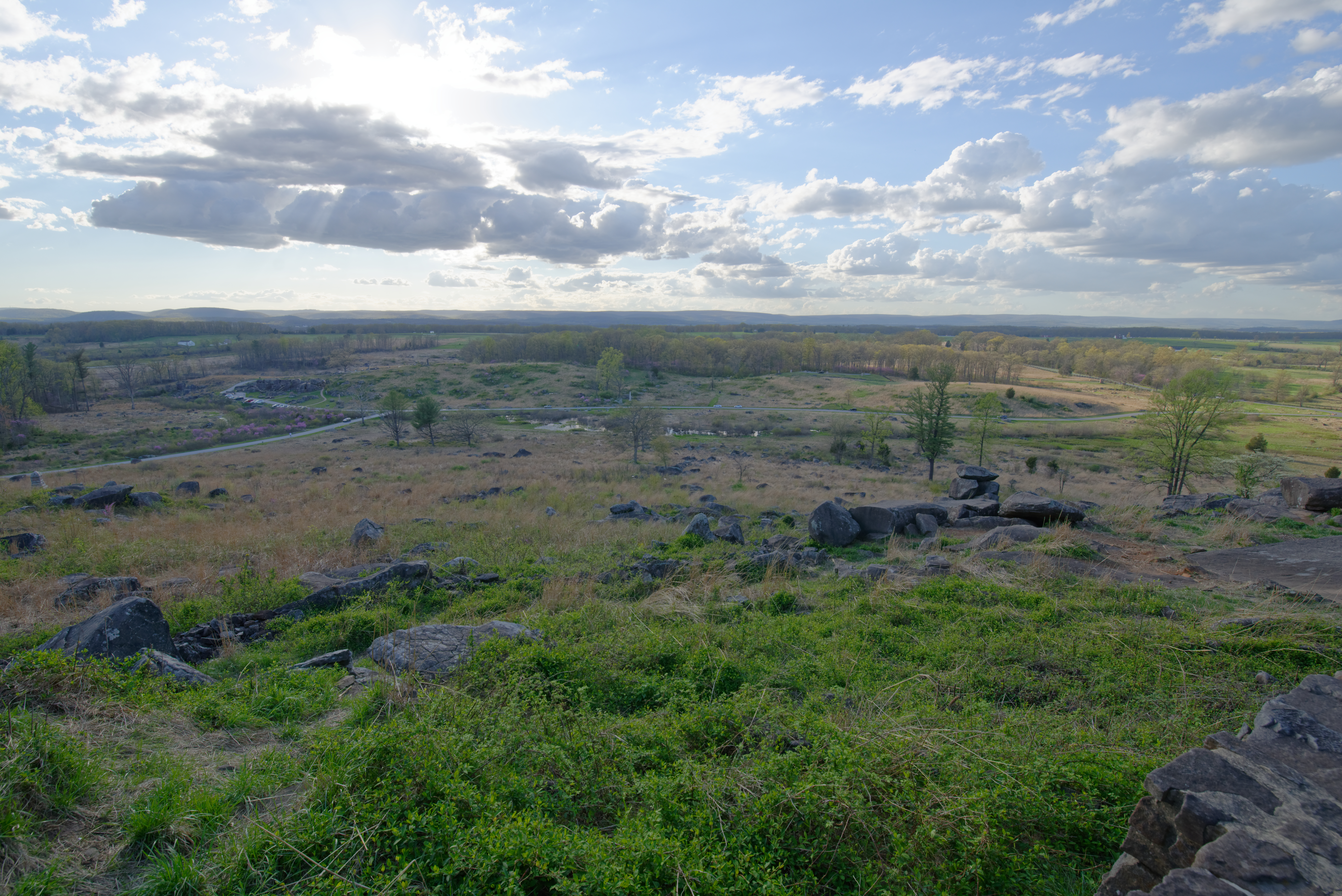
History & Significance
Gettysburg sits in the Cumberland Valley foothills of south-central Pennsylvania, a market town that existed for a century before the war arrived. By the summer of 1863 it stood at the junction of eleven roads, which is why two armies converged on it without intending to. The Battle of Gettysburg, fought from July 1 through July 3, 1863, became the largest battle ever fought in the Western Hemisphere, with roughly 160,000 soldiers engaged over three days of fighting across ridgelines, orchards, boulder fields, and wheat fields that had been ordinary farmland the week before.
The Union Army of the Potomac, commanded by General George Meade, held the high ground south of town along Cemetery Ridge. General Robert E. Lee's Army of Northern Virginia attacked from the west and north, then launched the assault remembered as Pickett's Charge across nearly a mile of open ground on the final afternoon. The charge broke against Union rifle and artillery fire, and Lee withdrew to Virginia. He never again mounted a major offensive into the North.
The dead were buried where they fell. In November 1863, the bodies of Union soldiers were reinterred in the new Soldiers' National Cemetery, and President Abraham Lincoln traveled from Washington to speak at the dedication. His address, fewer than 275 words long, reframed the meaning of the war in language that has not lost its force. The Confederate dead remained in temporary graves until the 1870s, when they were returned to the South.
Before any of this, Adams County was York County territory, and before that, the ground was contested by the Susquehannock Nation, the Lenape, and the Iroquois Confederacy as the colonial frontier pushed west. The town was laid out in 1786 by James Gettys, who received a warrant for the land under the Pennsylvania land grant system. What Gettys platted as a commercial crossroads became, seventy-seven years later, the turning point of the Civil War.
Three days that turned the war
The first day of battle, July 1, began by accident. Confederate infantry moving toward Gettysburg to requisition shoes encountered Union cavalry west of town. The fighting escalated through the morning as both sides fed reinforcements into the engagement, and by afternoon the outnumbered Union forces were driven back through the town streets to the high ground of Cemetery Hill south of Gettysburg. That high ground proved decisive.
On July 2, Lee attacked both Union flanks simultaneously. On the left, fighting surged through the Peach Orchard, the Wheat Field, Devil's Den, and up the rocky slopes of Little Round Top, where Union infantry from Maine held the extreme end of the Federal line in close combat that left the hillside covered with dead from both sides. On the right, fighting raged through a cemetery, a culvert, and a brick farmyard at Culp's Hill until after midnight. Both attacks failed to break the Union position.
July 3 opened with renewed fighting at Culp's Hill before Lee ordered his main assault: roughly 12,500 Confederate infantry crossing three-quarters of a mile of open ground under artillery and rifle fire toward the Union center at Cemetery Ridge. The charge reached the wall at a slight angle in the Federal line called the Angle, where hand-to-hand fighting lasted minutes before the Confederate formation dissolved. Of the men who stepped off Seminary Ridge that afternoon, more than half were casualties before the assault ended.
The farms and the families who owned them
The farms on which the battle was fought belonged to real families who had worked them for generations. The Codori farm, the Trostle farm, the Rose farm, the Weikert farm: each name appears in Adams County deed records running back to the eighteenth century, when Pennsylvania issued warrants and surveys to settlers purchasing land under the state's proprietary system. The families who had planted those fields and built those barns did not leave voluntarily. Most sheltered in cellars while the armies fought across their land.
The destruction was total for some and severe for nearly all. Fences torn down for firewood. Crops trampled. Wells fouled. Livestock taken or killed. Barns converted to field hospitals and left soaked in blood. The damage claims filed by Adams County farmers with the state of Pennsylvania after the battle provide one of the most detailed accountings of the material cost of three days of fighting: hundreds of claims, each itemized down to the number of fence rails lost and the pounds of hay consumed.
Federal land records for Adams County show the transfer pattern before and after the battle. Some families sold out and left. Others rebuilt and stayed. The farmland that was the battlefield in 1863 was gradually acquired by the federal government over the following decades, a process that continued well into the twentieth century as the National Park Service assembled the battlefield we know today from the patchwork of private holdings it had been.
The address and the ground it consecrated
The Soldiers' National Cemetery at Gettysburg was established immediately after the battle on a proposal from Pennsylvania Governor Andrew Curtin, who visited the field in July 1863 and was appalled by the condition of the Union dead. The cemetery commission hired landscape architect William Saunders, who designed a layout grouping the Union dead by state in semicircular rows facing a central point. Reinterment of some 3,500 Union soldiers was underway when the formal dedication was held on November 19, 1863.
Edward Everett, the most celebrated orator in America, spoke for two hours. Lincoln followed with remarks he had finished preparing that morning. His 272 words redefined what the nation was fighting for: not merely the preservation of the Union, but the completion of the promise in the Declaration of Independence that all men are created equal. Everett wrote to Lincoln the next day acknowledging that Lincoln had said more in two minutes than he had in two hours.
The Confederate dead were not included in the national cemetery. They remained in temporary graves on the battlefield until 1872, when Southern women's memorial associations coordinated their removal to Hollywood Cemetery in Richmond, Blandford Cemetery in Petersburg, and other Southern burial grounds. The separate fate of the Confederate dead is a matter of record in the cemetery ledgers, the correspondence of the memorial associations, and the county deed books that record the land transactions underlying each section of the battlefield as it passed into public ownership.