History & Significance
Idaho City sits in a narrow mountain valley where Moore's Creek joins the South Fork of the Boise River, in the Boise Basin of Boise County. It was founded in 1862 after a prospecting party discovered placer gold in the basin's creek gravel, triggering one of the largest gold rushes in Pacific Northwest history. Within a year, the Boise Basin contained the largest concentration of population in the Pacific Northwest, with Idaho City alone reaching a population of approximately 7,000 people, making it larger than Portland, Oregon, at the time.
The gold of the Boise Basin was extraordinarily rich in its early years. The placer deposits covered an area of roughly twenty square miles, and the creeks running through the basin had concentrated gold over geological time in the gravel beds to depths that allowed surface-level extraction to continue profitably for years. The district as a whole produced an estimated $250 million in gold between 1862 and the late 1870s, a figure that made it one of the most productive gold districts in American history.
Idaho Territory was created by Congress in 1863 partly in response to the need to govern the suddenly large population of the Boise Basin. Idaho City served as the territorial capital briefly and as the most important commercial center in the interior Northwest for much of the 1860s. It had four major newspapers, six churches, several hotels, dozens of saloons, a theater, and the full commercial apparatus of a prosperous frontier city.
The Boise Basin had been Shoshone and Bannock territory. The discovery of gold brought thousands of American miners into an area where the Shoshone-Bannock had been guaranteed protection under treaties that the federal government did not enforce. The violence that followed the rush, and the displacement of Indigenous peoples from their traditional grounds, followed the pattern established in California and Nevada: rapid, brutal, and ultimately nearly total.
The rush and the city it built
The prospecting party that found gold in the Boise Basin in August 1862 was part of a broader wave of prospectors moving northward from the California and Nevada fields in search of new deposits. The Boise Basin was not entirely unknown: Hudson's Bay Company trappers had worked the region for decades, and there had been earlier prospecting activity in the Snake River country. But the 1862 discovery in Moore's Creek and its tributaries was on a scale that immediately attracted mass migration.
The mining camps that grew in the basin during 1862 and 1863 coalesced into the town of Idaho City, which was formally laid out and named in 1863 and quickly became the commercial hub of the district. The town's geography was constrained by the narrow valley, which limited expansion but concentrated the commercial activity into a dense urban strip along the main street. The resulting townscape was compact, intensely commercial, and subject to the catastrophic fires that affected most wood-frame western mining towns.
Idaho City burned four times in its first decade, in 1865, 1867, 1868, and 1871. Each fire destroyed much of the commercial district, and each was followed by rapid rebuilding. The Boise County deed records from this period document the rapid property transactions associated with each rebuild: lots sold, buildings reconstructed, ownership patterns reshuffled after each disaster. The cycle of fire and rebuilding was an economic as well as a physical phenomenon, redistributing wealth and ownership at each iteration.
The Chinese miners and the exclusion economy
Among the tens of thousands of miners who came to the Boise Basin were several thousand Chinese workers, many of them veterans of the California gold rush and the Central Pacific Railroad construction who moved to each new western mining district in search of work. The Chinese miners in Idaho City and the surrounding Boise Basin performed much of the reworking of placer deposits that had been abandoned by American miners as too low-grade to be profitable, applying more labor-intensive techniques to extract gold that the initial rush had left behind.
The legal and social position of Chinese miners in Idaho Territory reflected the combination of exclusion and exploitation that characterized the Chinese experience in the American West generally. The Boise County records document special taxes on Chinese miners, restrictions on their claims, and a legal status that denied them the property rights available to white miners. Chinese miners could not own their mining claims outright in many districts, could not testify against white men in court, and faced periodic violent expulsion from districts that white miners decided they wanted to reclaim.
The Chinese contribution to the total gold production of the Boise Basin was substantial. The reworking of abandoned placer ground, which the Chinese miners specialized in, extended the productive life of the district significantly. The Idaho City Chinatown, one of the largest in the Pacific Northwest, is documented in the Boise County records, the census returns, and the contemporary newspaper coverage, providing a reasonably complete picture of a community that was economically essential and legally marginalized.
The Boise County records and what they document
The Boise County Records from the Idaho City era are an unusually complete documentary record of a mining boomtown, preserved in the county courthouse that survived four major fires through a combination of luck and the stone-and-brick construction of the government buildings. The claim books from the early 1860s document the initial staking of the Boise Basin's placer ground in real time, recording the claims of individual miners in the weeks and months after the initial discovery.
The deed records from the 1860s and 1870s document the rapid transaction cycle of a mining community: individual claims sold to companies, companies selling out after the placer was exhausted, lots changing hands multiple times in a single year during the boom period. The probate records document the estates of miners who died before they could remove their gold from the territory, sometimes including detailed inventories of their mining equipment and accumulated gold dust.
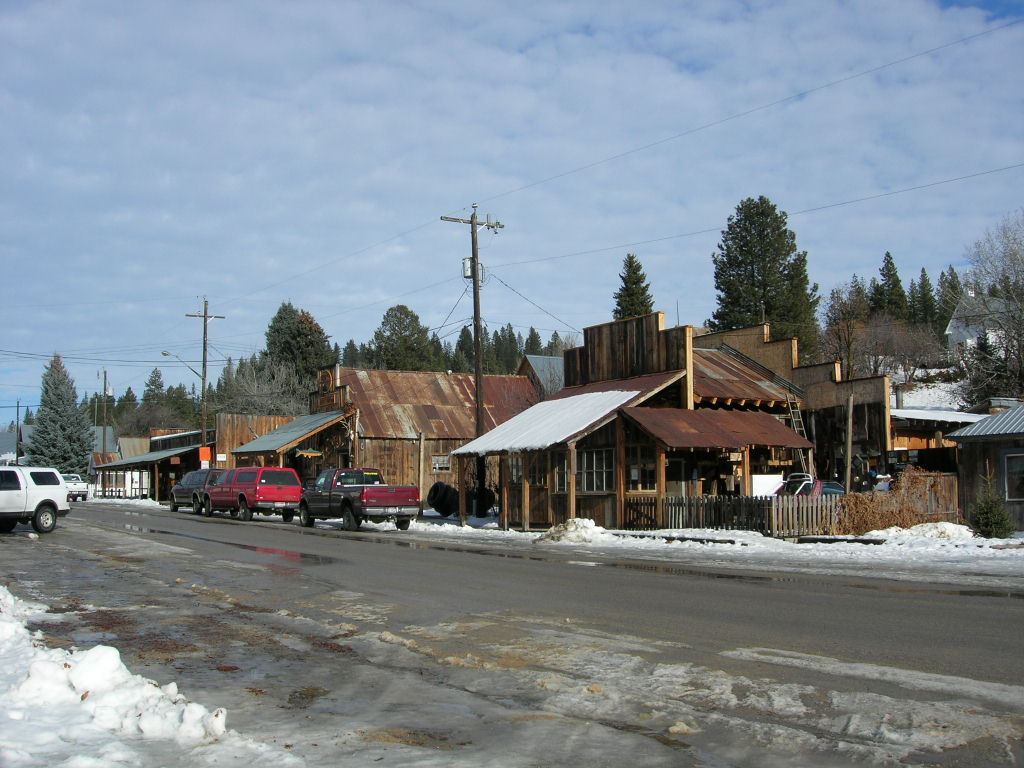
The surviving built environment of Idaho City is modest compared to what it was at the peak: one major fire in 1867 and the gradual departure of the mining population reduced the town to a fraction of its boom-era size. But the buildings that remain, including the Boise Basin Mercantile, the original jail, and several residences, are among the oldest surviving commercial and residential structures in Idaho. Combined with the Boise County documentary record, they make Idaho City one of the best-documented examples of a Pacific Northwest gold rush community.