History & Significance
Mineral Point sits in the driftless hills of southwest Wisconsin, a town of limestone and lead that owes its existence entirely to a geological accident - an unusually rich concentration of galena ore lying close to the surface. The first Americans to exploit it in the early 1820s were rough-and-ready miners from Missouri and the American Bottom of Illinois, men who worked the diggings seasonally and lived in shallow earthwork shelters dug into the hillsides. They gave Wisconsin its enduring nickname: the Badger State.
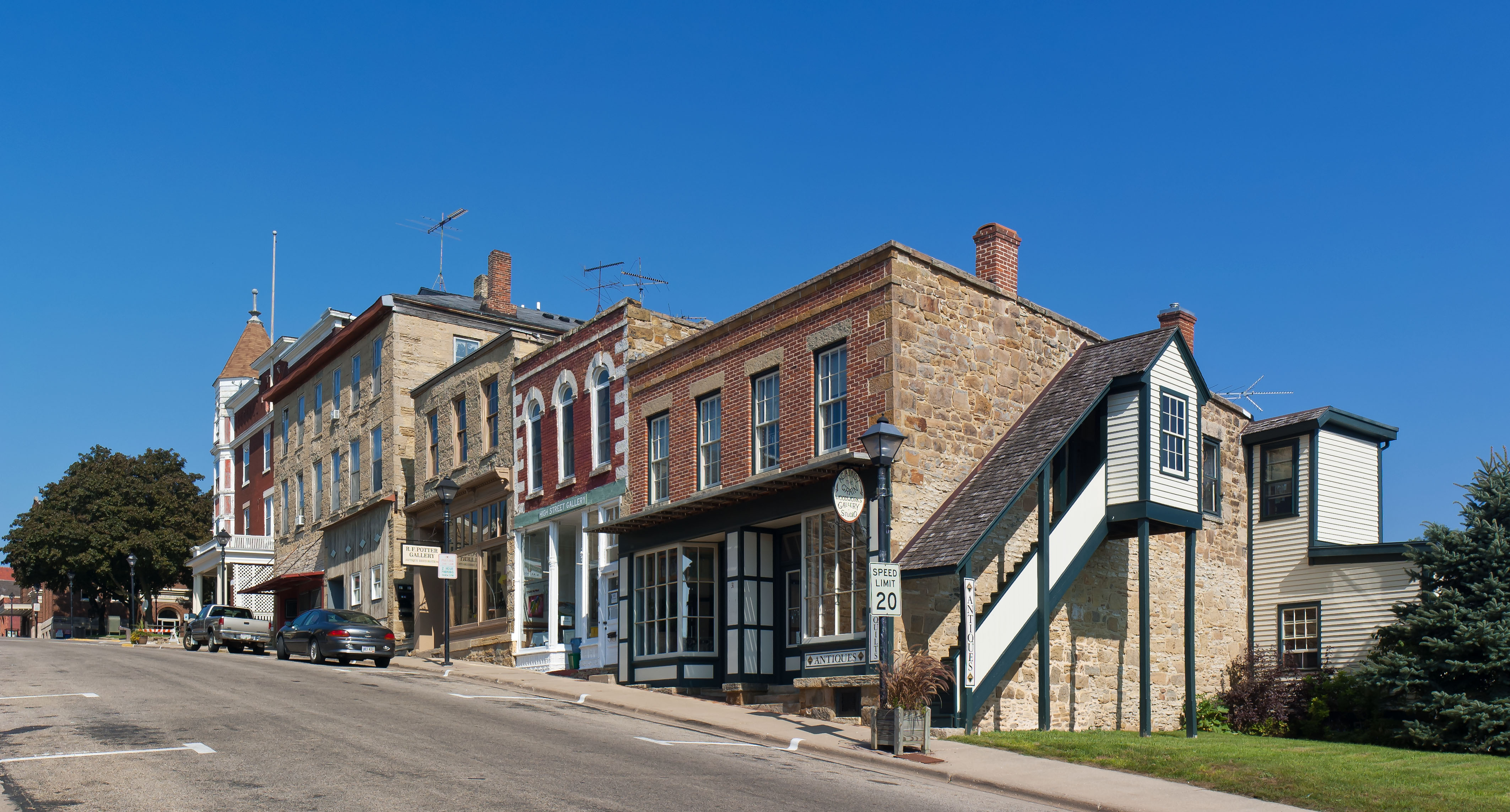
The town that grew from those makeshift camps became one of the most consequential in early Wisconsin territory. Henry Dodge, the first Governor of Wisconsin Territory, made his political base here. Mineral Point became one of the largest concentrations of Cornish immigrants in American history, miners from Cornwall who brought hard-rock expertise and a distinctive building tradition in local limestone. Their stone cottages, some little more than one or two rooms, survive in the historic district now preserved as Pendarvis, a Wisconsin Historic Site.
Before any of this, the land was Ho-Chunk territory. The Ho-Chunk Nation had long made their home in the region's river valleys and prairies. A series of land cession treaties in the 1820s and 1830s stripped them of their claims to this mineral-rich ground. The lead rush that built Mineral Point was constructed directly on that dispossession - a pattern repeated across the American frontier, but documented here with unusual clarity in federal land records and treaty archives.
The lead rush that built a territory
Lead had been mined by Indigenous peoples in the southwest Wisconsin region long before European contact, and French traders knew of its deposits as early as the seventeenth century. But it was American miners, arriving in force from Missouri and Illinois in the early 1820s, who transformed the landscape. By 1825 there were several hundred men working the diggings around what would become Mineral Point. By 1830 the number had grown to several thousand.
The mining was surface-level at first - galena ore found just a few feet below the topsoil, extracted by teams working with picks and blasting powder. The men who did this work were not farmers or tradesmen: they were itinerant mineral hunters, following the ore across a landscape that was changing faster than any government map could track. The town of Mineral Point was platted in 1828, given a name that simply described what was there, and almost immediately became the commercial hub of the Wisconsin lead district.
The territory's importance to the United States was economic as much as strategic. Lead was essential for ammunition, paint, and plumbing. The mines at Mineral Point and the surrounding district supplied much of the nation's output through the 1830s and 1840s. When the federal government organized Wisconsin Territory in 1836, it was the lead district - and Mineral Point above all - that justified the investment.
The Cornish miners and their stone cottages
Around 1833, the first Cornish miners began arriving in Mineral Point. They came from a culture of hard-rock mining - tin and copper, not the surface-level lead of the American frontier - but they adapted quickly, and they brought skills that the American miners lacked: knowledge of deep shafts, proper timbering, and efficient ore processing.
The Cornish also brought something less tangible: a fierce attachment to their own identity. They built in limestone rather than wood, replicating the vernacular architecture of Cornwall in the hills of Wisconsin. The result was a town that looked, in certain streets, more like a Cornish village than an American frontier settlement. The cottages they built were small, solid, and practical - fieldstone and quarried limestone, lime-plastered inside, with gardens and root cellars that spoke of people intending to stay.
By the 1840s, Mineral Point and the surrounding southwest Wisconsin mining district had one of the largest concentrations of Cornish immigrants in America. The names on the land records and in the church registers - Treloar, Trevithick, Pengelly, Pascoe - were the names of southwest England transplanted wholesale into the American Midwest. Their descendants still live in Iowa County. The Pendarvis Historic Site, operated by the Wisconsin Historical Society, preserves a row of their original stone cottages and interprets the Cornish contribution to the town's history.
The original federal land grant
When the federal government surveyed southwest Wisconsin and opened it to legal purchase, it applied the Public Land Survey System - the township and range grid that divided the American frontier into townships of 36 square miles, each divided into 36 numbered sections of roughly 640 acres. Every acre of land in Mineral Point that is privately held today traces its legal title back to a federal patent issued by the Bureau of Land Management's predecessor, the General Land Office.
The earliest federal patents in this area were issued in the 1830s and 1840s, as the General Land Office surveyed and opened the lead district to formal purchase. The grantees - recorded by name, date and parcel description in the BLM General Land Office database - were among thousands of settlers who formalised their claims to Wisconsin land once the survey system caught up with the rush of settlement. Each patent is a matter of public record, describing the exact township, range and section of the parcel conveyed.
That patent sits at the head of a chain of title that runs to the present day. Every subsequent deed, sale, mortgage, and inheritance in that chain is recorded in the Iowa County Register of Deeds. The original grant is not just a historical curiosity - it is the legal foundation of property ownership in this part of Wisconsin, a document that connects a square of land in the driftless hills to the full weight of American federal law.