The Mexican War and the 1850s frontier, 1846 to 1860
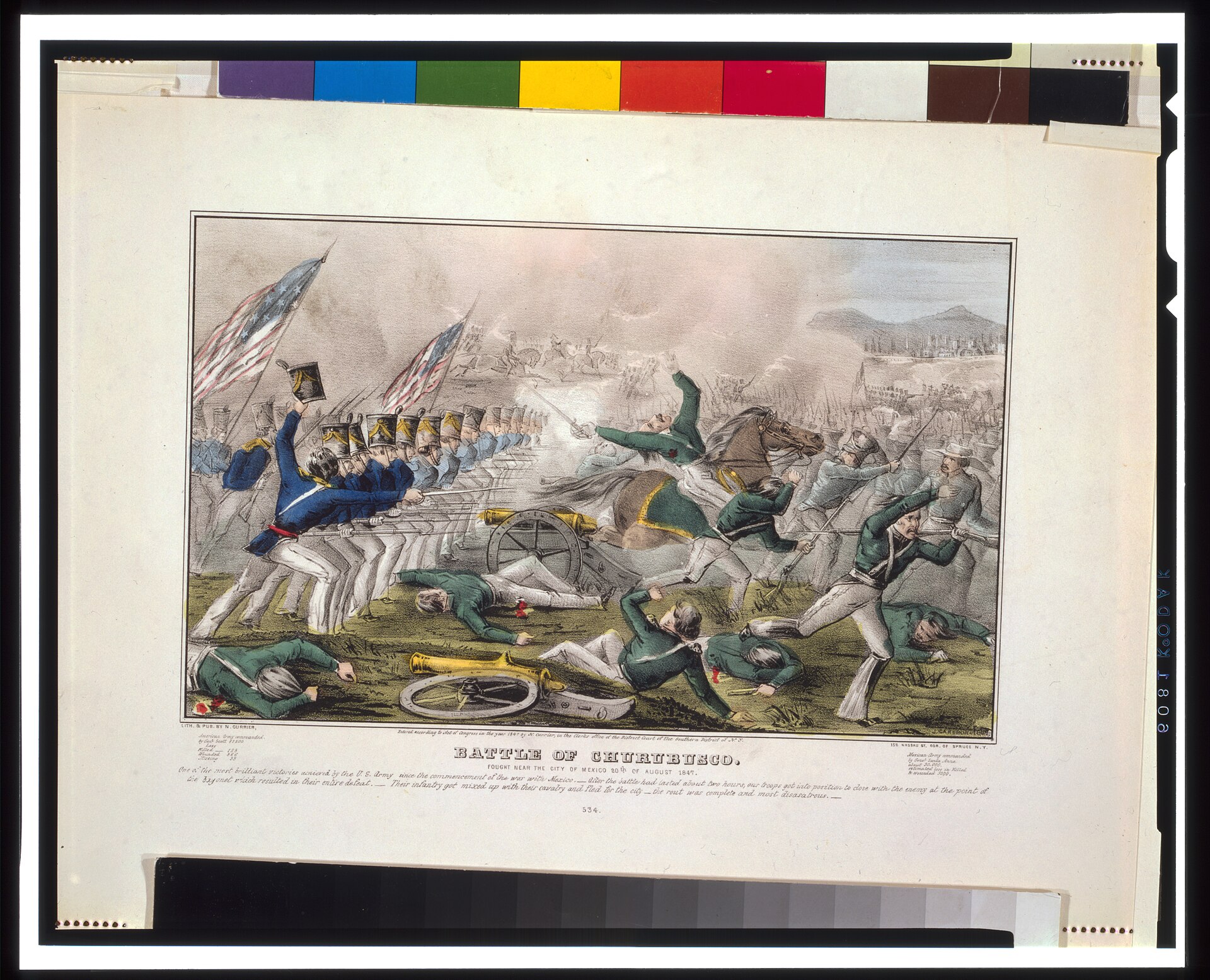
The years from 1846 to 1860 opened with a declared war and closed on the edge of a civil one. The first conflict was the Mexican-American War, fought from the Rio Grande at Palo Alto and Monterrey to Winfield Scott's march inland from Veracruz and the storming of Chapultepec above Mexico City. The peace that followed did not bring quiet to the West. Through the 1850s the army and the territorial militias fought a running series of frontier and civil conflicts: the Indian wars of California and the Pacific Northwest, the guerrilla struggle over slavery in Kansas, the confrontation with the Mormon settlers of Utah, and hundreds of smaller actions recorded in the army's own chronological register. The engagements gathered here are drawn from that documented record, each tied to a named place and, where the record allows, a date and an outcome.
Mexican-American War
Mexico entered the conflict with an army riddled by weakness and internal division. Of the nineteen states making up the Mexican federation, a mere seven contributed troops, weapons, and funding toward the fight. Concern about the nation's readiness was widespread among its leadership, and Santa Anna himself remarked that the army's leaders had done what they could to drill the rough volunteers who joined up, yet found it nearly impossible to instill in them any real devotion to the country they served. Lucas Alamán, a prominent conservative figure in Mexican politics, observed that funds poured into arming Mexican forces served mainly to let them turn on one another, creating merely the appearance that the nation possessed a defensive army. One officer, meanwhile, took aim at how Santa Anna had prepared the troops, noting that cavalry drills never went beyond the regimental level, that artillery units rarely maneuvered and never so much as fired a blank round, and that the commanding general himself was absent from field exercises, leaving him ignorant of what his various units could actually do. This same officer added that no one knew whether the top commanders ever gathered to discuss campaign strategy, or whether any plan for the campaign existed at all.
At the war's outset, Mexico's military was split into two categories: standing forces known as permanentes and militia units called activos. The permanent establishment comprised twelve infantry regiments (each made up of two battalions), three artillery brigades, eight cavalry regiments, a lone independent squadron, and a brigade of dragoons. The militia contributed nine infantry regiments and six of cavalry. Farther north, scattered frontier settlements relied on presidial companies, the presidiales, for protection.
Mexican soldiers carried leftover British muskets from the Napoleonic era, the Brown Bess among them. American troops early on were armed similarly, with flintlock Springfield 1816 muskets, though as fighting continued, more dependable caplock weapons gained favor. Certain American units wielded far more advanced arms that gave them a real edge, including the Springfield 1841 rifle used by the Mississippi Rifles and the Colt Paterson revolver carried by the Texas Rangers. Later in the war, Colt Walker revolvers went to the Mounted Rifles, a weapon the Army had ordered a thousand of back in 1846. Perhaps above all, American artillery's superior quality tipped the balance again and again throughout the fighting.
Writing his memoirs in 1885, former president Ulysses Grant, who had served in the war himself, pointed to Mexico's shoddy military organization as the root of its defeat. He described the private soldier as drawn from the poorest classes without any say in the matter, clothed badly, fed worse, rarely paid, and discharged once no longer needed. The junior officers, he wrote, stood only marginally above their men in quality. Yet Grant conceded that he had witnessed acts of bravery from these soldiers equal to any he had seen elsewhere. He noted that Mexico had since built an army larger than that of the United States, complete with a military academy patterned on West Point, staffed by educated and undoubtedly courageous officers, concluding that a war like that of 1846 to 1848 could no longer happen in his own time.
Political fracture within Mexico severely hampered its capacity to wage war. Centralist conservatives and federalist liberals struggled constantly for control, and on occasion factions within the Mexican military turned their weapons on each other rather than on the invading Americans. Santa Anna himself lamented, with evident bitterness, that however humiliating it was to say so, Mexico had inflicted this disgrace upon itself through endless internal fighting.
Mexican presidents during this period rotated through office in spans measured sometimes in months, sometimes in mere weeks or days. Just before hostilities began, liberal General José Joaquín de Herrera held the presidency from December 1844 to December
California Indian Wars
Los Angeles County's European-American settlers quickly saw an opportunity in Indian labor, since the local economy suffered a shortage of workers after able-bodied EuroAmericans rushed off to the gold fields. Throughout the 1850s, white Americans across the Western United States relied on Amerindian workers to farm extensive tracts of land while paying them barely anything, or nothing at all. Many rancho owners profited handsomely during the Gold Rush years by moving their herds into the Central Valley and the foothills of the Sierra, taking advantage of the boom years that mining had created. As mining demands fueled broader economic growth, even Indigenous communities living far off, such as those in the Coso Range, found themselves drawn into this system.
Coerced labor, particularly involving children, was common throughout Southern California, and so called "Domesticated Indians" formed a substantial share of the region's early inhabitants. These individuals were essentially forced servants, frequently abducted and transported to cities such as Los Angeles and San Francisco to labor in homes or as workers.
This spread of forced servitude took a heavy toll on many tribes, with those in the south bearing the brunt of it. By 1852, a third of native boys had been bound into servitude, while 65 percent of native women were indentured before reaching age fifteen. Kidnappers often raided northern areas and brought Indigenous children south to towns for this purpose.
Native girls held in these arrangements commonly suffered sexual abuse, and many were seized straight from reservations before enduring severe mistreatment. Women accounted for nearly half of all those indentured. Anyone accused of vagrancy or other offenses could likewise be sentenced into forced labor without much process. Children under fourteen made up three quarters of California's entire indentured native population.
Throughout this genocide, Southern California's native peoples frequently faced near starvation while also being burdened with taxes. Cupeno leader Antonio Garra responded by organizing an uprising among the people of San Diego County against these hardships. His rebellion grew into one of the largest such revolts in Southern California before Cahuilla leader Juan Antonio brought about his capture.
Disease outbreaks and hunger further devastated the state's Indigenous population, with Southern California tribes enduring both smallpox epidemics and massacres. Groups including the Cahuilla, Gabrielino, and Yokut, often pushed to the edge by starvation, resorted to taking horses and livestock. By the end of this genocide, nearly every group known as "Mission Indians" in California had been rendered landless, their communities scattered by force and their territory seized by incoming settlers.
Bleeding Kansas
The intensifying quarrel over slavery in the United States, and the widening gap between those who championed abolition and those who opposed it, left Congress trying to hold a fragile equilibrium between its Northern and Southern members. Meanwhile, growing numbers of Americans were pushing westward, and dreams of a transcontinental railroad linking the eastern seaboard to California added pressure to fold the western territories into the Union.
Looming over all of this was a persistent dilemma: what stance these new territories would take on slavery once they sought statehood. Lawmakers had already wrestled with this question in the wake of the Mexican-American War. The Compromise of 1850 offered a stopgap solution, letting people in the Utah and New Mexico Territories settle the slavery question themselves through popular vote, a move that reshaped how the broader debate would unfold.
Then, in May 1854, the Kansas-Nebraska Act carved the territories of Kansas and Nebraska out of Indian lands for American settlement. Illinois senator Stephen A. Douglas introduced this legislation partly to win over Southern lawmakers, who had blocked earlier attempts to bring Nebraska into the fold under the terms of the Missouri Compromise of 1820. That older law had banned slavery throughout federal territory lying north of the 36°30' line and west of the Mississippi, Missouri excepted. Southern politicians worried that adding Nebraska would tip the scales toward free states, handing Northern abolitionists greater leverage in Congress.
To ease these concerns, Douglas split the region into two territories rather than one and wrote in a "popular sovereignty" clause echoing the earlier arrangement for Utah and New Mexico. Settlers of Kansas and Nebraska would themselves decide the legality of slavery within their borders, an approach that flatly contradicted the Missouri Compromise and, in practice, dissolved it, since both territories sat entirely north and west of the boundary that document had drawn.
Douglas, along with many of his colleagues, figured Nebraska's settlers would vote against slavery while Kansas, situated farther south and bordering the slave state of Missouri, would embrace it, leaving the overall balance undisturbed. His read on Nebraska proved accurate; slavery never took hold there, and its future as free soil was essentially guaranteed. Kansas told a different story. The assumption of an easy proslavery outcome failed to account for how fiercely abolitionists would resist the undoing of a compromise that had stood for decades. Southerners hailed the new law as a triumph; Northerners branded it a shameful betrayal. Both camps recognized Kansas as the place to make their stand, and the territory swiftly turned into the nation's foremost ideological battlefield, as well as its bloodiest.
The phrase "Bleeding Kansas" gained currency through Horace Greeley's New-York Tribune. Its earliest use of "Kansas, bleeding" appeared on June 16, 1856, describing remarks from the North American National Convention, where a Colonel Perry of Kansas predicted that his suffering state would deliver more indirect votes for the eventual presidential nominee than any other in the Union. Weeks later, on September 13, 1856, the Tribune printed a poem by Charles S. Weyman containing the now-familiar phrase "bleeding Kansas."
Settlers backing both sides of the slavery dispute rushed into Kansas Territory, eager to claim residency and voting rights. Many of the earliest arrivals hailed from slave states, particularly neighboring Missouri, bringing firm Southern loyalties and a determination to see slavery take root in Kansas. These proslavery newcomers founded towns such as Leavenworth and Atchison. President Franklin Pierce's administration stacked territorial offices with proslavery appointees, and spurred by rumors that Northerners were flooding the frontier, thousands of outsiders sympathetic to slavery poured into Kansas to sway local politics.
Through fraud and intimidation, proslavery factions dominated the territory's early elections. In November 1854, armed bands from Missouri known as "Border Ruffians" or "Southern Yankees" crossed into Kansas by the thousands and tipped the vote for territorial delegate toward proslavery Democrat John Wilkins Whitfield. A congressional investigation in 1855 uncovered 1,729 fraudulent ballots against only 1,114 legitimate ones. In one precinct, a mere 20 of 604 voters actually lived in the territory; in
Utah War
Between May 1857 and July 1858, US government troops and Mormon settlers in Utah Territory found themselves locked in a tense military standoff now remembered under several names: the Utah Expedition, the Utah Campaign, the Mormon War, the Mormon Rebellion, and, less flatteringly, Buchanan's Blunder. What began as friction over how much self-rule the territory should enjoy gradually pulled federal soldiers and local settlers into direct opposition. Casualties did occur, with most of the dead being civilians who were not themselves Mormon.
No major battles were fought during the standoff itself, yet the period was marked by one horrific episode: the Mountain Meadows Massacre. There, members of a Mormon militia stripped roughly 120 California-bound travelers of their weapons before killing them, an atrocity historians link in part to the heightened anxieties stirred up by the broader Utah conflict.
Eventually the dispute was settled at the negotiating table. Federal soldiers were permitted to march into Utah Territory, and in return Mormon settlers received a pardon covering any acts of rebellion they might have committed. This arrangement eased hostilities considerably, restoring federal control over the territory while still leaving Mormon interests and self-governance largely intact. Even so, public opinion at the time judged the whole episode a failure for President Buchanan, whose mishandling of events earned it the lasting nickname "Buchanan's Blunder." Many historians further argue that the war, compounded by Buchanan's missteps, helped fuel the sectional tensions that would erupt into the Civil War in 1861.
Synthesised from the documented record and the Wikipedia articles for the named conflicts: Mexican-American War; California genocide; Bleeding Kansas; Utah War.
The conflicts
The band runs from the declared war with Mexico to the frontier and territorial fighting of the 1850s. Each conflict is gathered here with its engagements.
Where the fighting fell
The fighting ranged from the Rio Grande and the Pacific coast to the Kansas prairie and the Great Basin. Each state carries its own record of engagements. Select a state to see them.
Notable engagements
| Engagement | State | Year | Outcome | Forces or losses |
|---|---|---|---|---|
| Thornton Affair | TX | 1846 | Mexico victory | 14 killed; 6 wounded; 1 fatally wounded; 59 captured vs… |
| Siege of Fort Texas | TX | 1846 | United States victory | 2 killed; 10 wounded vs 2 killed; 2 wounded; 3 prisoners… |
| Battle of Palo Alto | TX | 1846 | United States victory | 9 killed; 47 wounded; 2 missing vs 102 killed; 129 wounded… |
| Battle of Resaca de la Palma | TX | 1846 | United States victory | 33 killed; 89 wounded vs 154 killed; 205 wounded; 156… |
| Battle of Monterey | CA | 1846 | United States victory | None vs None |
| Battle of Dominguez Rancho | CA | 1846 | Mexico victory | |
| Battle of El Brazito | NM | 1846 | United States victory | 11 or 43 killed; 17or ~150 wounded vs 7 wounded |
| Temecula massacre | CA | 1846 | Mexico victory | 33-40 Luiseño Natives, with 20+ prisoners killed vs Unknown |
| Battle of Chino | CA | 1846 | Mexico victory | 1 killed; 2 wounded vs 24 captured; 3 wounded |
| Battle of Natividad | CA | 1846 | United States victory | Total: 13-25 |
| Siege of Los Angeles | CA | 1846 | Mexico victory | 48 captured vs None |
| Capture of Yerba Buena | CA | 1846 | United States victory | 0 vs 0 |
Plus 22 further documented engagements in the the Mexican War and the 1850s frontier record.
Engagements and locations are compiled from published sources: Wikipedia (text rewritten and cited as a reference, CC BY-SA 4.0); Wikidata (structured data, CC0); Heitman's Historical Register (1903) (public domain (U.S. federal record), Chronological List of Battles).