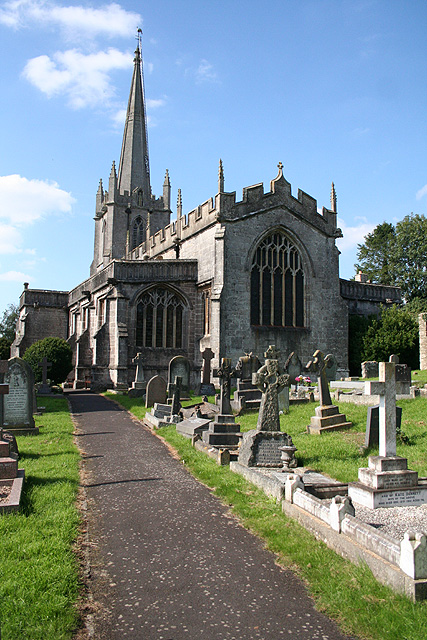
Martin Bodman / Wikimedia Commons / CC BY-SA 2.0
History & Significance
Croscombe is a village of a few hundred people on the southern edge of the Mendip Hills, midway between Wells and Shepton Mallet. The road through it is quiet; the houses are a mixture of limestone cottages and Victorian red brick; the stream that gives the village its name (Cros Cumb, the cross valley) runs along the main street. Nothing in the exterior announces that the church of St Mary the Virgin contains what several architectural historians have described as the finest collection of Jacobean church fittings in Somerset.
The prosperity that paid for those fittings came from wool. Croscombe lay at the heart of the medieval Somerset cloth-making industry, which stretched across the Mendip plateau and the valleys below it from the fourteenth to the seventeenth centuries. The villages of this zone — Shepton Mallet, Glastonbury, Wells, and dozens of smaller settlements including Croscombe — grew wealthy on the proceeds of cloth production, exporting finished wool cloth through the Bristol merchants to continental Europe. The churches they built and furnished in those centuries are the visible record of that wealth.
The fittings at St Mary's date primarily to the early seventeenth century — the decades around 1610–1640 — when the cloth trade was still producing profits sufficient for ambitious church improvement. The carved wooden screen, pulpit, reader's desk, and bench ends are all of high quality, produced by craftsmen who understood the vocabulary of Jacobean decorative art: strapwork, columns, arched panels, heraldic ornament. They form a remarkably complete ensemble for a village church of this size.
The Jacobean fittings
The screen at Croscombe is the outstanding piece. It separates the nave from the chancel and carries the arms of several local families, with a central arch supported by columns and decorated with strapwork panels. The craftsmanship is of a quality that would not be out of place in a major cathedral. The pulpit, standing at the south side of the nave, is a three-decker of Jacobean type — clerk's desk, reading desk, and pulpit proper — decorated with carved panels of architectural ornament. It retains its original tester (sounding board) above.
The bench ends are carved with a variety of motifs: animals, foliage, figures, and heraldic devices. Some are clearly matched pairs; others appear to be individual commissions, suggesting that the seating was provided by different donors over a period of years. This kind of individual sponsorship of church furnishings was common in the late medieval and early Jacobean period: wealthy clothiers, merchants, and local gentlemen paid for specific elements of the church interior as acts of piety and displays of status.
The church also retains a fifteenth-century fan-vaulted porch — unusual for a parish church of this size — and a medieval font. The building itself is largely Perpendicular Gothic of the fifteenth century, consistent with the period of greatest cloth-trade prosperity, though there are earlier fabric traces. The combination of the Perpendicular shell and the Jacobean fittings gives St Mary's an unusual coherence: a building that reflects two distinct phases of wealth in the same community.
The Somerset wool trade
The medieval Somerset cloth industry was centred on the Mendip plateau and the valleys of the Frome, Brue, and Shepton rivers. Water power from the fast-flowing Mendip streams drove the fulling mills that finished woven cloth; the open upland grazings supported large flocks of sheep; and the Bristol trade routes gave access to continental markets. By the fifteenth century, Somerset was one of the most productive cloth-making counties in England, second only to the Cotswolds in the value of its output.
The villages of the Mendip zone grew rich proportionally. The churches of Shepton Mallet, Evercreech, Batcombe, and their neighbours are among the grandest Perpendicular Gothic buildings in the south of England — disproportionate in scale and quality to the populations they served, and explicable only by the extraordinary wealth of the clothier class that funded them. Croscombe is a smaller, more modest example of the same phenomenon: a village that punched above its weight architecturally because its wool money allowed it to.
The trade declined in the seventeenth century as new cloth-producing centres in the West Riding of Yorkshire and in East Anglia outcompeted the traditional Somerset producers. The Jacobean fittings at Croscombe were probably installed near the end of the prosperous period — a final investment in the church interior before the economic conditions that had sustained such expenditure became less favourable. The Somerset cloth industry lingered into the eighteenth century but never recovered its medieval scale.
Croscombe in the medieval period
Croscombe appears in the Domesday Book of 1086 under the Somerset survey, recorded as a settlement of moderate size with several manorial components. The village's subsequent medieval history is documented in the records of the bishops of Bath and Wells — the diocese to which the parish belonged — and in the accounts of the various lay manorial lords who held parts of the vill through the thirteenth and fourteenth centuries.
The parish registers for Croscombe survive from the sixteenth century and are held at the Somerset Heritage Centre in Taunton. The registers record the usual demographic events — baptisms, marriages, burials — but also provide evidence for the clothier families who formed the upper tier of village society in the Jacobean period. Surnames like Rossiter, Hyatt, and Dyer appear with a frequency and in a context (church benefactions, substantial bequests) that marks them as the prosperous artisan-merchant class of the cloth trade.
The Somerset Heritage Centre holds a substantial collection of manorial and estate records for the area, supplementing the parish register evidence with information on land tenure, agricultural practice, and estate management. For genealogical researchers, the combination of parish registers, probate records, and manorial documentation makes the Mendip villages, including Croscombe, relatively well documented from the sixteenth century onwards.
Visiting Croscombe
St Mary the Virgin is normally open during daylight hours. The church is well maintained by the local community and the fittings are in good condition, regularly cleaned and cared for. Visitors are welcome; a simple guide to the building is usually available inside. The church is on the standard itinerary for architectural tourists following the medieval churches of the Somerset Mendip zone, and it is frequently mentioned in guides to English church woodwork and Jacobean ecclesiastical art.
The village of Croscombe itself is small but attractive. The Mendip Hills rise steeply to the north; the valley bottom below the village is flat and water-meadow in character. The A371 Wells to Shepton Mallet road runs through the village, providing good access. Wells Cathedral, three miles to the west, is a natural complement to a visit — the great Gothic cathedral that was the religious and administrative centre of the diocese to which Croscombe belonged.
For walkers, the Mendip plateau above the village is accessible via footpaths from the village street. The plateau landscape — limestone grassland, drystone walls, the occasional swallet hole — is the grazed upland that sustained the sheep of the medieval cloth industry, and walking it gives a physical sense of the agricultural foundations on which the church fittings below were built.
See the full research report for Croscombe, Somerset
Scheduled monuments, Domesday records, geology, Roman roads, historical literature: the same report Aubrey generates for paying customers, free to read.
View full reportGet an Aubrey report for anywhere in the UK
An Aubrey Research report for Croscombe would map all PAS-recorded finds from the Mendip and North Somerset area, identify every scheduled monument within five kilometres, and cross-reference the village's Domesday entry. The Somerset Mendip landscape is rich with prehistoric, Roman, and medieval sites — hillforts, lead-workings, drove roads, and the earthworks of medieval cloth-trade communities. For anyone researching Somerset family history or the history of the medieval cloth trade, Aubrey provides the full historical picture.
Start your reportEverything a full report reveals about Croscombe, Somerset
You have just read the story of Croscombe, Somerset. A full Aubrey report pulls together everything the record actually holds about a place, from the geology beneath it to the last coin dropped in a field:
Every location is different. Not every section appears for every place, only what the historical record actually holds turns up in a report.