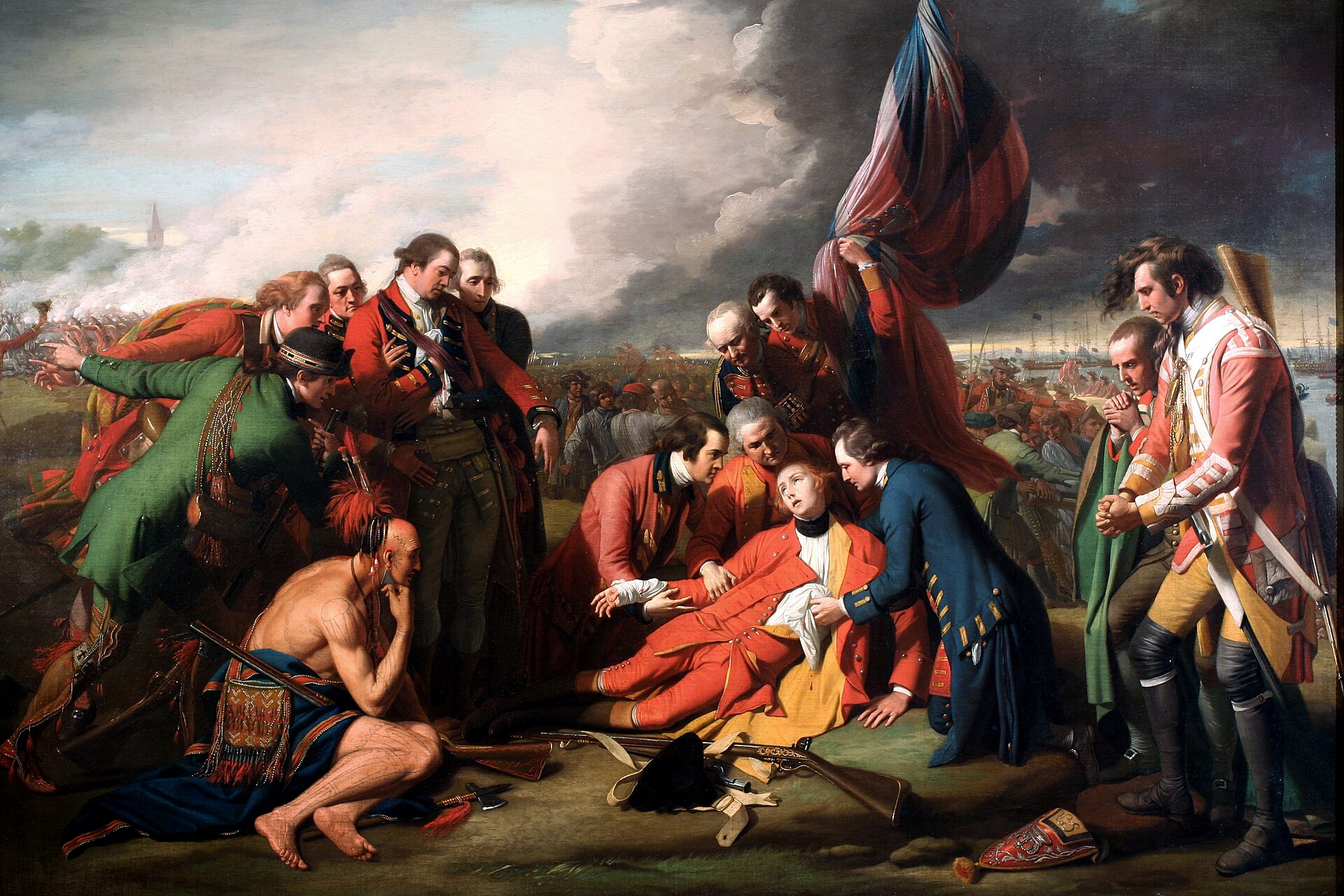
Between 1754 and 1763, Great Britain and France fought one another across North America, each supported by Indigenous nations that people at the time referred to as "Indians." This struggle is typically classified by scholars as a theater within the broader Seven Years' War, a global contest spanning 1756 to 1763, though many in the United States prefer to treat it as its own separate affair, disconnected from European rivalries.
Although the 1748 Treaty of Aix-la-Chapelle had formally ended hostilities between the two powers, commercial friction persisted throughout their North American holdings. Eventually this friction sharpened into a struggle over control of the Forks of the Ohio and the nearby French stronghold of Fort Duquesne. Matters escalated in May 1754, when Virginia militia under George Washington's command struck a French patrol at what became known as the Battle of Jumonville Glen.
The following year, Edward Braddock, newly appointed as Commander-in-Chief for North America, devised a plan to strike the French from four directions simultaneously. Every prong of this scheme failed, and the expedition led personally by Braddock met catastrophe on July 9 at the Battle of the Monongahela, where Braddock himself sustained fatal wounds and died soon afterward. Additional British campaigns waged in Pennsylvania and New York between 1755 and 1757 likewise came to nothing, though these setbacks were partly counterbalanced by Britain's seizure of Fort Beauséjour, situated along the frontier separating British Nova Scotia from French Acadia. During the nine years that followed, colonial authorities forced French inhabitants out of Acadia and repopulated the region with settlers drawn from New England.
Once the wider Seven Years' War erupted in 1756, a string of catastrophic British efforts the next year, among them the failed Louisbourg Expedition and the loss at the Siege of Fort William Henry, brought down the government back in Britain. His successor as Prime Minister, William Pitt, poured far greater military resources into the colonial war effort at precisely the moment France found itself unable to adequately supply its own forces in New France, having chosen instead to focus its strength on the European theater. From 1758 through 1760, British forces mounted a sustained push to seize French Canada altogether, capturing Quebec in 1759 and then Montreal the year after. With this, organized combat in North America effectively came to a close.
Under the terms of the Treaty of Paris signed in 1763, France surrendered its Canadian territories to Britain, together with any claims it held over lands lying east of the Mississippi River. Separately, through the Treaty of Fontainebleau, France transferred Louisiana west of the Mississippi to its ally Spain, offering this as compensation for what Spain had lost to Britain. What remained of France's North American foothold shrank to nothing more than the small islands of Saint Pierre and Miquelon, cementing Britain's status as the continent's leading colonial power.
Background
By the mid-eighteenth century, the land east of the Mississippi River fell mostly under the competing claims of Britain and France, though vast stretches remained without any colonial presence at all. France's colonial population, numbering roughly 75,000, clustered heavily in the St. Lawrence River valley, with additional settlers in Acadia, a region covering modern New Brunswick and parts of Nova Scotia, and on Île Royale, known today as Cape Breton
Céloron's expedition
Governor-General Roland-Michel Barrin de La Galissonière of New France grew alarmed at how far British colonial traders, men like George Croghan, had pushed into the Ohio Country and how much sway they held there. Acting on that unease, he directed Pierre-Joseph Céloron in June 1747 to march a military force through the region. Several goals drove this mission: reminding New France's Indian allies that only traders sanctioned by New France could deal with them, securing Indian cooperation in upholding the French claim to lands French explorers had already staked out, keeping the British from forging ties with nearby tribes, and demonstrating French military strength to deter settler encroachment, unsanctioned trading ventures, and other violations of French territorial claims.
Roughly 200 Troupes de la marine and 30 Indians made up Céloron's force, and together they traveled nearly 3,000 miles (4,800 km) from June through November of 1749. Their route carried them up the St. Lawrence, along Lake Ontario's northern edge, across the Niagara portage, and then along Lake Erie's southern coast. Near Barcelona, New York, at the Chautauqua Portage, the group turned inland toward the Allegheny River and followed it down to what would become Pittsburgh. It was there that Céloron interred lead plates bearing inscriptions asserting France's claim over the Ohio Country. Any British colonial merchants or fur traders he came across were warned of these claims and ordered to depart.
When the expedition reached Logstown, local Indians made clear to Céloron that the Ohio Country belonged to them, not the French, and that they intended to keep trading with the British regardless. Undeterred, Céloron pressed on southward until reaching where the Ohio and Miami rivers met, close to Pickawillany, home to the Miami leader known as "Old Briton." Céloron cautioned this chief that dire consequences awaited if trade with the British continued, but the warning fell on deaf ears. By November 1749, a discouraged Céloron had made his way back to Montreal.
He later composed a thorough account of the journey. In his own words, the Natives of these localities showed hostility toward the French and firm loyalty to the English, and he confessed uncertainty about how such sentiments might be reversed. Even before Céloron reached Montreal, word of conditions in the Ohio Country had already begun reaching both London and Paris, with each government weighing possible responses. Among those pushing hardest for action was William Shirley, governor of Massachusetts, who argued bluntly that British colonists could never be secure while French forces remained in the region.
Written by Aubrey Research from French and Indian War on Wikipedia, cited as a reference and not reproduced.
Where these engagements were fought
All 60 are placed on the map. Select a marker to see the engagement.
Red markers are surveyed battlefields with a mapped boundary; navy markers are point-located engagements. Select a marker to open its page.
Notable engagements
| Engagement | State | Year | Outcome | Forces or losses |
|---|---|---|---|---|
| Battle of Jumonville Glen | PA | 1754 | British victory | French ~10 killed, most captured |
| Battle of the Monongahela | PA | 1755 | French-Indian victory | French 39 killed; British 457 killed |
| Battle of Fort Oswego | NY | 1756 | French victory | British 80-150 killed, 1,700 captured |
| Battle of the Trough | WV | 1756 | Shawnee-Lenape victory | Virginia 7 dead |
| Kittanning Expedition | PA | 1756 | Pennsylvanian victory | Pennsylvania 17 killed; Lenape 9 killed |
| Battle of Great Cacapon | WV | 1756 | Shawnee-Lenape victory | Virginia 18+ killed |
| Battle of Sideling Hill | PA | 1756 | Lenape victory | Pennsylvania 20 killed |
| Siege of Fort William Henry | NY | 1757 | French-Indian victory | British 130-185 killed, 2,308 captured |
| Attack on German Flatts (1757) | NY | 1757 | Franco-Indian victory | 40-50 killed, 150 captured |
| Vaudreuil's raid | NY | 1757 | British victory | France: Unknown; Great Britain: Unknown (destruction of… |
| Battle on Snowshoes (1757) | NY | 1757 | Inconclusive | British 14 killed |
| Battle of Sabbath Day Point | NY | 1757 | French-Indian victory | British 160 killed, 90 captured |
Plus 48 further documented engagements in the French and Indian War record.
Every engagement with a page
All 31 engagements in this record that have their own detailed page, in date order.
By state
Engagements and locations are compiled from published sources: Wikipedia (text rewritten and cited as a reference, CC BY-SA 4.0); Sylvester, Indian Wars of New England (1910) (public domain).