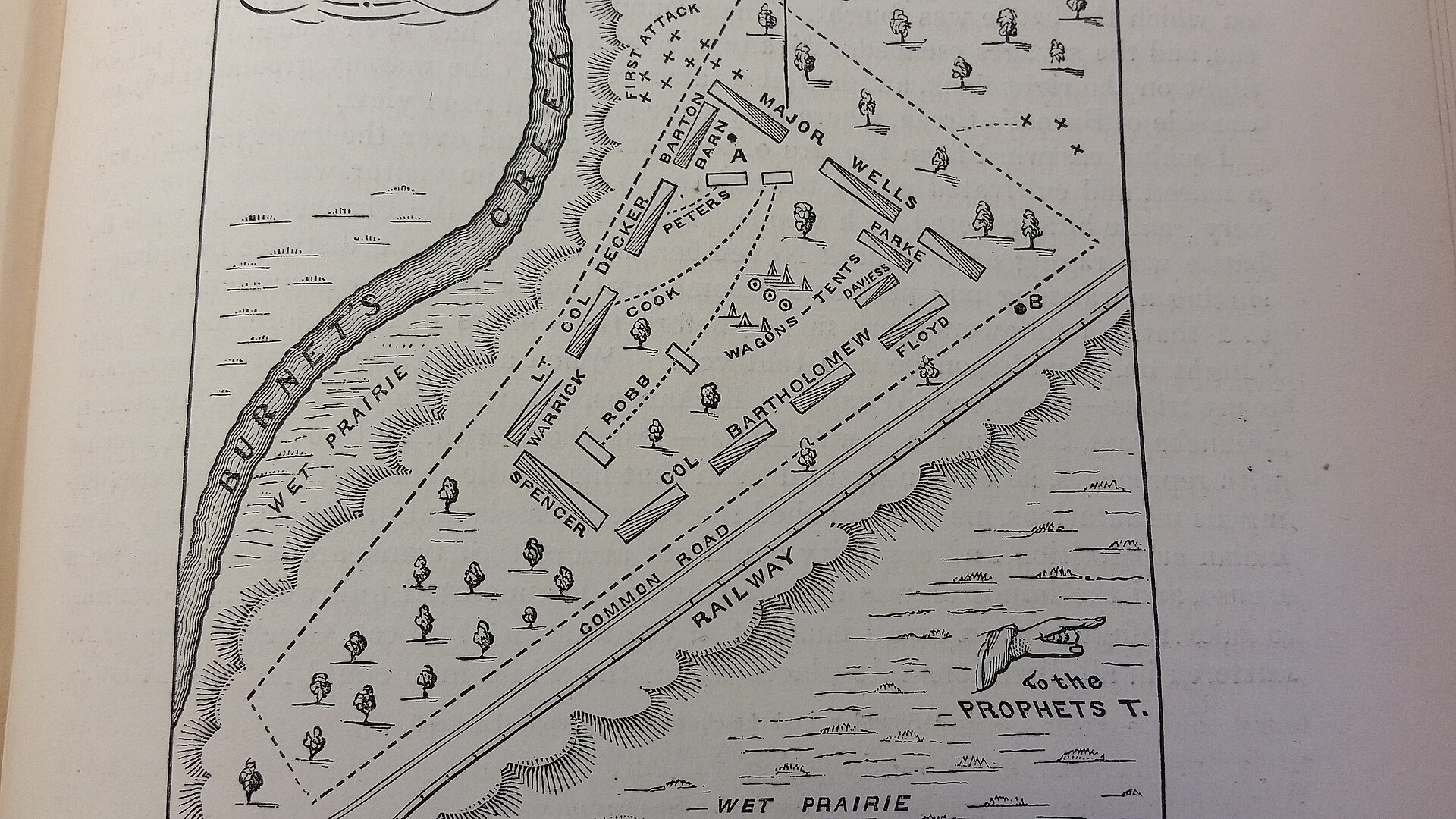
The Black Hawk War pitted the United States against Native Americans under Black Hawk, a Sauk leader, in a conflict rooted in disputed land claims. Fighting began when Black Hawk led a mixed group of Sauks, Meskwakis (Fox), and Kickapoos, called the "British Band," across the Mississippi from Iowa Indian Territory into Illinois during April 1832. Historians remain uncertain of his exact intentions, though he seems to have wanted to recover territory the United States had absorbed through the contested Treaty of St. Louis in 1804.
Believing the British Band posed a genuine threat, American officials called up frontier militia forces, who fired on a Native American delegation on May 14, 1832. Black Hawk retaliated with a decisive strike against the militia at Stillman's Run. Afterward he withdrew his followers to a defensible position in what is today southern Wisconsin, drawing U.S. troops in pursuit. With the militia occupied elsewhere, other Native groups launched raids on poorly defended forts and settlements. Some warriors from the Ho-Chunk and Potawatomi joined these attacks, though most members of those tribes stayed out of the fighting. The Menominee and Dakota, already rivals of the Sauks and Meskwakis, sided with the Americans.
General Henry Atkinson directed the American pursuit of the British Band. On July 21, Colonel Henry Dodge's militia overtook the group and won the Battle of Wisconsin Heights. Starvation, mounting deaths, and desertions had by then depleted Black Hawk's forces, pushing many surviving Native Americans back toward the Mississippi. When U.S. troops caught up with what remained of the British Band on August 2, they struck at the Battle of Bad Axe, killing large numbers and taking most of the survivors prisoner. Though Black Hawk and several other leaders managed to flee, they eventually gave themselves up and spent a year in confinement.
Among the war's lasting footnotes is Abraham Lincoln's brief stint in uniform, though he never engaged in battle. Others who fought and later gained wider recognition include Winfield Scott, Zachary Taylor, Jefferson Davis, and James Clyman. The conflict subsequently served as justification for the government's Indian removal policy, under which Native American nations were compelled to cede their lands and relocate west of the Mississippi River.
Background
During the eighteenth century, the Sauk and Meskwaki, sometimes called the Fox, made their homes along the Mississippi in territory that later became Illinois and Iowa. This ground held special meaning for them, offering rich soil, abundant game, easy access to lead deposits, and waterways that supported trade. Displacement from the Great Lakes region during clashes with New France and rival tribes, especially the conflicts known as the Fox Wars that concluded in the 1730s, had drawn the two peoples into a tight bond. By the era of the Black Hawk War, their combined numbers stood near 6,000.
American expansion westward during the early nineteenth century drove federal officials to acquire as much tribal land as they could. William Henry Harrison, then territorial governor, brokered a treaty at St. Louis in 1804 under which certain Sauk and Meskwaki leaders reportedly gave up their eastern Mississippi lands in exchange for goods worth over $2,200 plus yearly payments of $1,000 in goods. Controversy dogged this agreement because the Native representatives lacked authorization from their councils to surrender territory. Historian Robert Owens has suggested the chiefs likely never meant to relinquish ownership, since they would hardly have parted with such prized land for so little. Historian Patrick Jung, by contrast, concluded the chiefs meant only to cede a small portion, but that American negotiators wrote the treaty to cover far more ground than the tribes realized, and that the true scope of the loss did not become clear to the Sauks and Meskwakis until much later.
Under the 1804 agreement, the tribes could keep using the ceded territory until the federal government sold it to settlers. For roughly twenty years afterward, the Sauk continued residing at Saukenuk, their main settlement near where the Rock River meets the Mississippi. Not until 1828 did the government start surveying this land for colonization, and Indian agent Thomas Forsyth then told the Sauk to abandon Saukenuk and their other villages on the eastern side of the river.
Opinion split among the Sauk over whether to fight the disputed treaty's enforcement. Most chose relocation west of the Mississippi over conflict with the United States, following Keokuk, who had once helped defend Saukenuk from American forces in the War of 1812. Though never a chief himself, Keokuk's gift for oratory made him the frequent voice of the Sauk civil leadership in dealings with Americans. He considered the 1804 treaty fraudulent, yet a 1824 visit to the sizeable cities of the eastern seaboard convinced him that resistance against the United States was futile.
Recognizing Keokuk's preference for peace, American officials showered him with gifts, hoping to entice him and his people across the Mississippi into Iowa. This strategy worked, and Keokuk led the majority of the tribe away. Yet around 800 Sauk, about a sixth of the population, refused to abandon their homeland. Leadership of this resistant faction fell in 1829 to Black Hawk, a war captain in his sixties who had also fought the Americans in 1812. Like Keokuk, he held no civil chieftainship, but he became Keokuk's chief rival for the tribe's loyalty. Ironically, Black Hawk had put his name to a May 1816 treaty confirming the contested 1804 cession, though he maintained that the document's wording did not match what had actually been discussed at the negotiations. As he put it, the whites habitually told the Indians one thing while recording something else entirely on paper.
Saukenuk, the village at the meeting point of the Rock and Mississippi Rivers where Black Hawk had been born and continued to live, remained his to defend as far as he was concerned. Returning from their winter hunt in 1829, the Sauk discovered squatters had taken over the village in expectation of its eventual sale. Months of friction with these settlers followed before the Sauk departed again in September 1829 for another winter hunt. Seeking to prevent further trouble, Keokuk assured Forsyth that his people would not go back to Saukenuk.
Ignoring warnings from both Keokuk and Forsyth, Black Hawk's followers nonetheless returned to Saukenuk in spring 1830, this time accompanied by over 200 Kickapoos, longtime allies of the Sauk. The group earned the label "British Band" for occasionally raising a British flag in defiance of American authority, and for their hopes of winning support from the British garrison at Fort Malden in Canada.
By 1831, when the British
Aftermath
Casualties from the conflict numbered 77 dead among settlers, militiamen, and regular troops, a tally that leaves out the men who perished from cholera within Winfield Scott's relief column. On the other side, estimates of losses among the British Band run from roughly 450 up to 600, meaning close to half of the 1,100 people who had crossed into Illinois alongside Black Hawk in 1832 perished.
Numerous Americans destined for political careers took part in the fighting. Seven men who would later become U.S. Senators served, along with four future governors of Illinois, plus men who would later govern Michigan, Nebraska, and the Wisconsin Territory. Two future presidents, Taylor and Lincoln, also fought. The conflict revealed to military leaders that mounted forces were essential when facing an enemy on horseback, since the regular Army fielded no cavalry at the time, relying only on part-time volunteer horsemen. Afterward, Congress established the Mounted Ranger Battalion, placing Henry Dodge in command, and this unit grew into the 1st Cavalry Regiment by 1833.
Following the fighting at Bad Axe, Black Hawk, Wabokieshiek, and those still with them fled northeast hoping the Ojibwes would shelter them. Authorities announced a bounty of $100 and forty horses for whoever captured Black Hawk. A Ho-Chunk man spotted the group while they camped near what is now Tomah, Wisconsin, and reported the sighting to his village's chief. Village leaders then sent representatives to persuade Black Hawk to give himself up to American forces. Surrender came on August 27, 1832, when Black Hawk and Wabokieshiek yielded to agent Joseph Street at Prairie du Chien. Zachary Taylor, holding the rank of colonel, took the captives into custody and had them transported by steamboat to Jefferson Barracks, with lieutenants Jefferson Davis and Robert Anderson serving as escort.
By the war's conclusion, twenty leaders total, including Black Hawk, were held at Jefferson Barracks. Officials freed most of these prisoners over the following months, though in April 1833 six men, among them Black Hawk, Wabokieshiek, and Neapope, were moved to Virginia's Fort Monroe, a facility better suited for confinement. Curiosity about the captured Natives ran high across the country, drawing enormous crowds in Louisville and Cincinnati eager to watch them pass by. On April 26 the group briefly met President Jackson in Washington before continuing on to Fort Monroe. Their celebrity status persisted even behind bars: painters including Charles Bird King and John Wesley Jarvis captured their likenesses, and a dinner was thrown in their honor before their departure.
Officials planned to free the men within weeks, but only after sending them on a tour of major eastern cities first. Such displays were common practice whenever Native leaders visited the East, based on the belief that showcasing American size and strength would dampen any future resistance to expansion. Starting June 4, 1833, Black Hawk and his companions were paraded through Baltimore, Philadelphia, and New York City, taken to dinners, plays, a battleship, government buildings, and a military review, always drawing massive throngs of onlookers. Nasheweskaska, known as Whirling Thunder and considered handsome, proved especially popular among the crowds. The mood shifted considerably out west, though; passing through Detroit on the journey home, the prisoners encountered a crowd that burned and hanged effigies representing them.
Historian Kerry Trask contends that the celebrity treatment given Black Hawk and the other prisoners stemmed from their role as living embodiments of the noble savage myth then popular in the eastern states. Trask argues that Americans, both at the time and afterward, used their admiration or sympathy for beaten figures like Black Hawk to absolve themselves of any role in dispossessing Native peoples. This same mythmaking, Trask suggests, carried forward into the numerous plaques and memorials later dedicated to Black Hawk's memory. As Trask puts it, most of what has been reconstructed about this conflict's memory was crafted to make white Americans feel good about themselves. Among Native Americans too, Black Hawk grew into a respected emblem of resistance, honored even by descendants of those who had once opposed him.
This war closed the chapter on armed Native resistance to American expansion in the Old Northwest. It gave officials like Andrew Jackson, L
Written by Aubrey Research from Black Hawk War on Wikipedia, cited as a reference and not reproduced.
Where these engagements were fought
14 of the 15 could be placed to a location and appear on the map; the remaining 1 are recorded without a precise point. Select a marker to see the engagement.
Red markers are surveyed battlefields with a mapped boundary; navy markers are point-located engagements. Select a marker to open its page.
Documented engagements
| Engagement | State | Year | Outcome | Forces or losses |
|---|---|---|---|---|
| Battle of Kellogg's Grove | IL | 1832 | Inconclusive | 8 KIA; 3 WIA vs at least 15 KIA |
| Battle of Waddams Grove | IA | 1832 | American victory | 3 KIA vs 2-6 KIA |
| Battle of Wisconsin Heights | WI | 1832 | U.S. victory | 1 killed; 8 wounded vs 40-70 killed |
| Sinsinawa Mound raid | IA | 1832 | British Band victory | 2 killed vs 0 |
| St. Vrain massacre | IL | 1832 | Ho-Chunk and Sauk victory | 4 vs 0 |
| Battle of Bad Axe | IA | 1832 | United States victory | At least 150 KIA (including non-combatants); 75 captured vs… |
| Battle of Stillman's Run | IL | 1832 | British Band victory | 3-5 killed vs 12 killed |
| Battle of Apple River Fort | IL | 1832 | United States victory | 1 KIA; 2 WIA vs Unknown |
| Buffalo Grove ambush | IL | 1832 | Kickapoo victory | 1 vs Not known |
| Spafford Farm massacre | IL | British Band victory | 4 killed vs 1 killed | |
| Indian Creek massacre | IL | 1832 | 15 killed, 2 captured | |
| Attack at Ament's Cabin | IL | 1832 | 1 KIA vs 0 |
Plus 3 further documented engagements in the Black Hawk War record.
Every engagement with a page
All 15 engagements in this record that have their own detailed page, in date order.
By state
Engagements and locations are compiled from published sources: Wikidata (structured data, CC0).