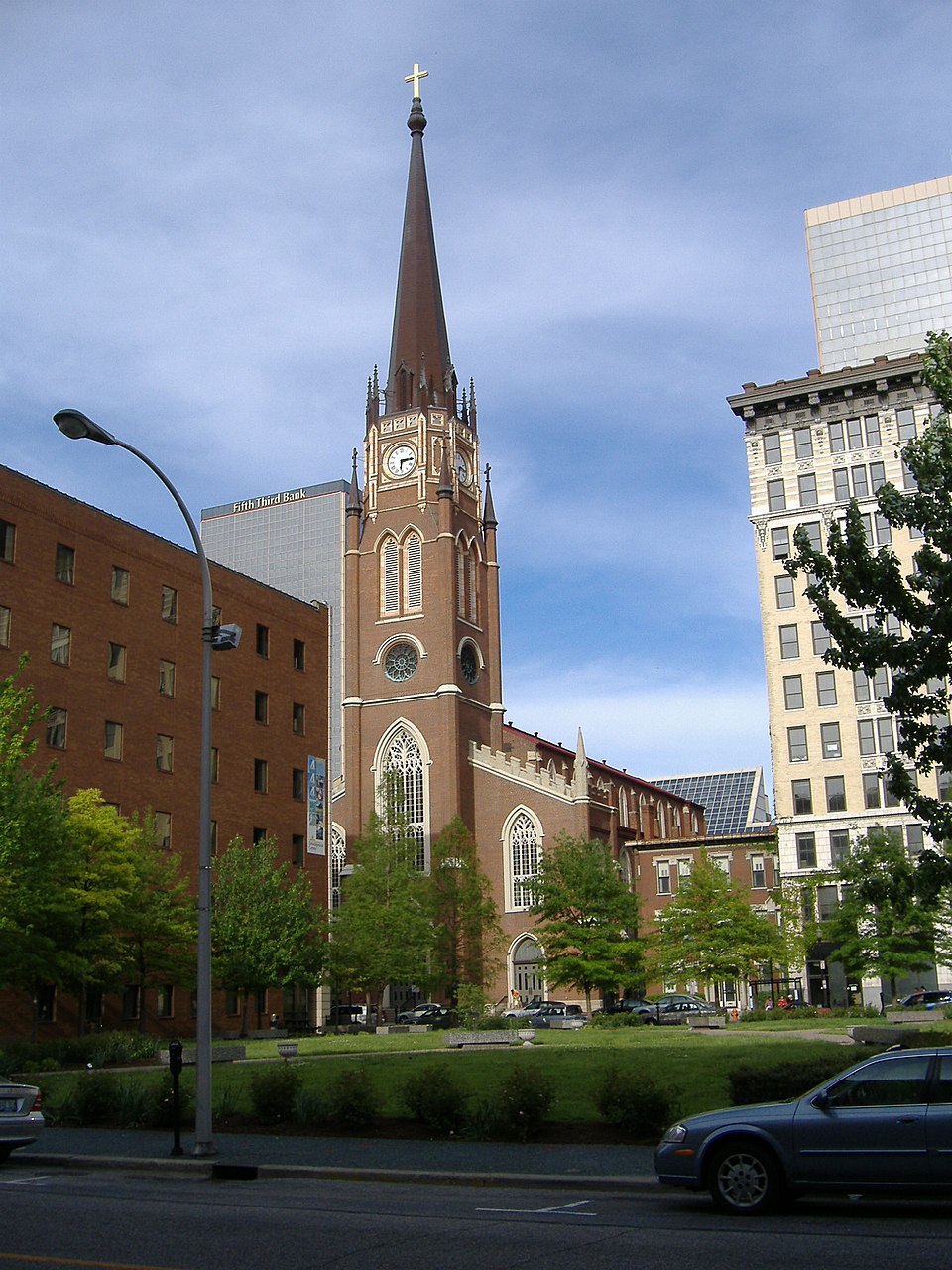
About this property
The Cathedral of the Assumption is a Catholic cathedral in Louisville, Kentucky, in the United States. It is the mother church of the Archdiocese of Louisville. As of 2025, it is the seat of Archbishop Shelton J. Fabre, and the Very Reverend Frederick W. Klotter serves as rector. The first Catholics arrived in present-day Kentucky in the 1770s from the Province of Maryland. They set up communities around Bardstown and its surrounding counties. Reverend Stephen Badin, the first priest ordained in the United States, periodically visited these communities while traveling west of the Alleghany Mountains. Pope Pius VII in 1808 erected the Diocese of Bardstown, the only diocese in the interior of the United States. At that time, the diocese included most of Kentucky along with the future states of Tennessee, Missouri, Illinois, Indiana, Ohio and Michigan. The pope named Reverend Benedict Joseph Flaget as the first bishop of Bardstown. In 1811, a small group of Catholics in Louisville formed Saint Louis Parish at 10th and Main Streets. The parish received its first resident pastor, Reverend Philip Hosten, in 1821. Hosten died one year later during an outbreak of yellow fever. By 1830, the parish had constructed a larger Saint Louis Church south of the Ohio River on Fifth Street. Over the coming decade, as the population grew in the American Midwest, the Vatican started subdividing the Diocese of Bardstown into other dioceses. By 1841, Louisville had become much larger than Bardstown and it made sense to move the episcopal seat there. On February 13, 1841, Pope Gregory XVI suppressed the Diocese of Bardstown and erected the Diocese of Louisville in its place, with Flaget as bishop. Flaget designated St. Louis Church as St. Louis Cathedral. In 1849, Flaget decided that the current cathedral building was inadequate. His plan was to build a new, larger cathedral around the old cathedral, then dismantle it piece by piece and carry them out the front door. The cornerstone for the new cathedral was laid in 1849. Flaget died in February 1850, leaving it to his successor, Bishop Martin John Spalding, to complete the project. On October 3, 1852, the new cathedral was dedicated to the Blessed Virgin Mary under the title of the Cathedral of the Assumption. The Cathedral of the Assumption was nearly destroyed during Bloody Monday, a major anti-Catholic riot in August 1855. Members of the nativist Know Nothing Party attacked Irish and German immigrants, mainly Catholics, throughout Louisville, killing 22 of them. The rioters threatened to burn the cathedral, believing that it was hiding firearms in its basement. However, Louisville Mayor John Barbee, himself a Know-Nothing member, inspected the cathedral and said there were no weapons.
Location
Categories
Property data from the National Register of Historic Places, National Park Service (public domain).
Description adapted from Wikipedia under the Creative Commons Attribution-ShareAlike 4.0 International License.
Everything a full report reveals about Cathedral of the Assumption
This page lists Cathedral of the Assumption. A full Aubrey report for an address near it pulls together this listing alongside battlefield records, land patents, and every other historical record within a chosen radius:
Every location is different. Not every section appears for every place, only what the historical record actually holds turns up in a report.
Questions about this property
When was Cathedral of the Assumption listed on the National Register?
Cathedral of the Assumption was listed on the National Register of Historic Places on September 20, 1977.
What type of historic resource is Cathedral of the Assumption?
Cathedral of the Assumption is classified as a building in the National Register of Historic Places.
What is the period of significance for Cathedral of the Assumption?
The period of significance for Cathedral of the Assumption is recorded as the industrial era.
Can I research the history near Cathedral of the Assumption?
Yes. Aubrey Research reports search National Register listings, battlefield records, land patents, and other primary historical sources within any radius of a US address. A report for an address near Cathedral of the Assumption will include this listing and all other historical records in the area.
More in Jefferson County
Historic places, battles, and census history across Jefferson County.
Explore JeffersonCounty ›More historic places in Kentucky
Browse all historic places in Kentucky.
View Kentuckyhistoric sites ›Research the history near this site
An Aubrey US report for an address near Cathedral of the Assumption will include this listing alongside battlefield records and other historical sources within your chosen radius.