About this property
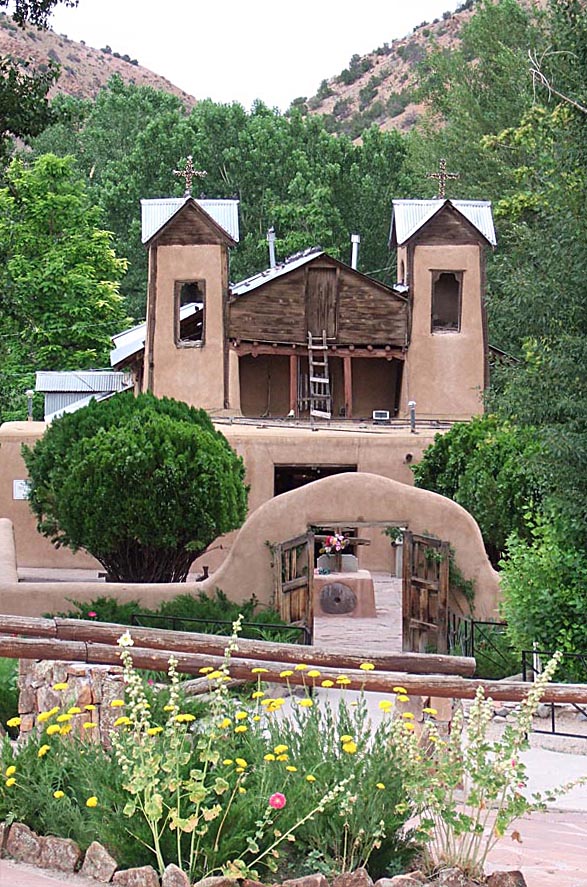
El Santuario de Chimayó is a Roman Catholic church in Chimayo, New Mexico, United States. (Santuario is Spanish for "sanctuary".) This shrine, a National Historic Landmark, is famous for the story of its founding and as a contemporary pilgrimage site. It receives almost 300,000 visitors per year and has been called "no doubt the most important Catholic pilgrimage center in the United States." The Santuario is on Juan Medina Drive in Chimayo. It is entered through a walled courtyard. Built of adobe with a bell tower on each side, the church is 60 feet (18 m) long and 24 feet (7.3 m) wide with walls more than 3 feet (about 1 m) thick. Pointed caps on the towers and a metal pitched roof (blocking the clerestory) were added after 1917, probably in the 1920s. The "elegant" doors were carved by the 19th-century carpenter Pedro Domínguez. An unusual feature is two side-by-side rooms at the entrance forming a vestibule or narthex, once used for storage. The nave contains a crucifix representing Christ of Esquipulas, 6 feet (1.8 m) tall. Other notable folk-art decorations include five reredoses and a small sculpture of St. James the Great. A small room called el pocito (the little well) contains a round pit, the source of "holy dirt" (tierra bendita) that is believed to have healing powers. An adjacent prayer room displays many ex-votos as well as photographs, discarded crutches, and other testimonials of those purportedly healed. In the early 19th century, 19 families lived in what was then called El Potrero de Chimayó (potrero means pasture). The land where the Santuario stands belonged to Don Bernardo Abeyta, one of the first members of Los Hermanos de la Fraternidad Piadosa de Nuestro Padre Jesús Nazareno (the Penitentes) in the area. He was probably devoted to the Christ of Esquipulas, a pilgrimage site in Guatemala where the clay is ascribed healing power. A nephew of Don Bernardo was christened Juan de Esquipulas in 1805. Bernardo Abeyta built a small chapel to the Christ of Esquipulas on the site around 1810. On November 15, 1813, he wrote to Father Sebastián Álvarez, the parish priest of Santa Cruz de la Cañada, asking him to write to the Episcopal See of Durango for permission to build a bigger church in which the people of El Potrero could worship Jesus as he appeared at Esquipulas and could hear Mass. The next day, Fr. Álvarez wrote the letter, mentioning that cures were reported and many pilgrims were arriving. On February 8, 1814, Francisco Fernández Valentín, Vicar General of the Diocese of Durango, wrote back with permission. By 1816 the chapel was replaced by the El Santuario shrine.
Location
Categories
Property data from the National Register of Historic Places, National Park Service (public domain).
Description adapted from Wikipedia under the Creative Commons Attribution-ShareAlike 4.0 International License.
Everything a full report reveals about El Santuario de Chimayo
This page lists El Santuario de Chimayo. A full Aubrey report for an address near it pulls together this listing alongside battlefield records, land patents, and every other historical record within a chosen radius:
Every location is different. Not every section appears for every place, only what the historical record actually holds turns up in a report.
Questions about this property
When was El Santuario de Chimayo listed on the National Register?
El Santuario de Chimayo was listed on the National Register of Historic Places on April 14, 1970.
What type of historic resource is El Santuario de Chimayo?
El Santuario de Chimayo is classified as a building in the National Register of Historic Places.
Is El Santuario de Chimayo a National Historic Landmark?
Yes. El Santuario de Chimayo has been designated a National Historic Landmark (NHL), the highest level of federal recognition for historic properties in the United States.
What is the period of significance for El Santuario de Chimayo?
The period of significance for El Santuario de Chimayo is recorded as the colonial era.
Can I research the history near El Santuario de Chimayo?
Yes. Aubrey Research reports search National Register listings, battlefield records, land patents, and other primary historical sources within any radius of a US address. A report for an address near El Santuario de Chimayo will include this listing and all other historical records in the area.
More in Santa Fe County
Historic places, battles, and census history across Santa Fe County.
Explore Santa FeCounty ›More historic places in New Mexico
Browse all historic places in New Mexico.
View New Mexicohistoric sites ›New Mexico history
Colonial settlement, territorial period, and statehood narrative.
New Mexicohistory ›Research the history near this site
An Aubrey US report for an address near El Santuario de Chimayo will include this listing alongside battlefield records and other historical sources within your chosen radius.