About this property
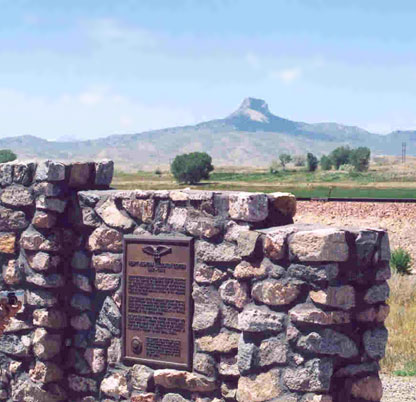
The Heart Mountain War Relocation Center, named after nearby Heart Mountain and located midway between the northwest Wyoming towns of Cody and Powell, was one of ten concentration camps used for the internment of Japanese Americans evicted during World War II from their local communities (including their homes, businesses, and college residencies) in the West Coast Exclusion Zone by the executive order of President Franklin Roosevelt (after the bombing of Pearl Harbor in December 1941, upon the recommendation of Lieutenant General John L. DeWitt). This site was managed before the war by the federal Bureau of Reclamation as the would-be site of a major irrigation project. Construction of the camp's 650 military-style barracks and surrounding guard towers began in June 1942. The camp opened August 11, when the first Japanese Americans were shipped in by train from the internment program's "assembly centers" in Pomona, Santa Anita, and Portland. The camp would hold a total of 13,997 Japanese Americans over the next three years, with a peak population of 10,767, making it the third-largest "town" in Wyoming before its November 10, 1945, closure. Among the inmates, the notation "心嶺山 (Shinreizan)" was sometimes applied. Heart Mountain is perhaps best known for many of its younger residents challenging the controversial draft of Nisei males from camp in order to highlight the loss of their rights through the incarceration. The Heart Mountain Fair Play Committee, led by Frank Emi and several others, was particularly active in this resistance, encouraging internees to refuse U.S. military induction until they and their families were released from camp and their civil rights were restored. Heart Mountain had the highest rate of draft resistance of all ten camps, with 85 young men and seven Fair Play Committee leaders ultimately sentenced and imprisoned for Selective Service Act violations. (At the same time, 649 Japanese American men—volunteers and draftees—joined the American military from Heart Mountain. In 1944, internees dedicated an Honor Roll listing the names of these soldiers, located near the camp's main gate.) In 1988 and 1992 the U.S. government passed laws formally apologizing to Japanese Americans for the internment-era violations of their constitutional, state, and personal property rights; and establishing a temporary fund to pay limited reparations ($20,000) to still-living former internees (or their children) who applied and qualified for them. The street grid and numerous foundations are still visible. Four of the original barracks survive in place. A number of others sold and moved after the war have been identified in surrounding counties and may one day be returned to their original locations. In early 2007, 124 acres (50 ha) of the center were listed as a National Historic Landmark. The Bureau of Reclamation owns 74 acres (30 ha) within the landmark boundary and currently administers the site. The remaining 50 acres (20 ha) were purchased by the Heart Mountain Wyoming Foundation, a nonprofit organization established in 1996 to memorialize the center's internees and to interpret the site's historical significance.
Location
Categories
Property data from the National Register of Historic Places, National Park Service (public domain).
Description adapted from Wikipedia under the Creative Commons Attribution-ShareAlike 4.0 International License.
Everything a full report reveals about Heart Mountain Relocation Center
This page lists Heart Mountain Relocation Center. A full Aubrey report for an address near it pulls together this listing alongside battlefield records, land patents, and every other historical record within a chosen radius:
Every location is different. Not every section appears for every place, only what the historical record actually holds turns up in a report.
Questions about this property
When was Heart Mountain Relocation Center listed on the National Register?
Heart Mountain Relocation Center was listed on the National Register of Historic Places on December 19, 1985.
What type of historic resource is Heart Mountain Relocation Center?
Heart Mountain Relocation Center is classified as a district in the National Register of Historic Places.
Is Heart Mountain Relocation Center a National Historic Landmark?
Yes. Heart Mountain Relocation Center has been designated a National Historic Landmark (NHL), the highest level of federal recognition for historic properties in the United States.
What is the period of significance for Heart Mountain Relocation Center?
The period of significance for Heart Mountain Relocation Center is recorded as the industrial era, specifically around 1941.
Can I research the history near Heart Mountain Relocation Center?
Yes. Aubrey Research reports search National Register listings, battlefield records, land patents, and other primary historical sources within any radius of a US address. A report for an address near Heart Mountain Relocation Center will include this listing and all other historical records in the area.
More in Park County
Historic places, battles, and census history across Park County.
Explore ParkCounty ›Research the history near this site
An Aubrey US report for an address near Heart Mountain Relocation Center will include this listing alongside battlefield records and other historical sources within your chosen radius.