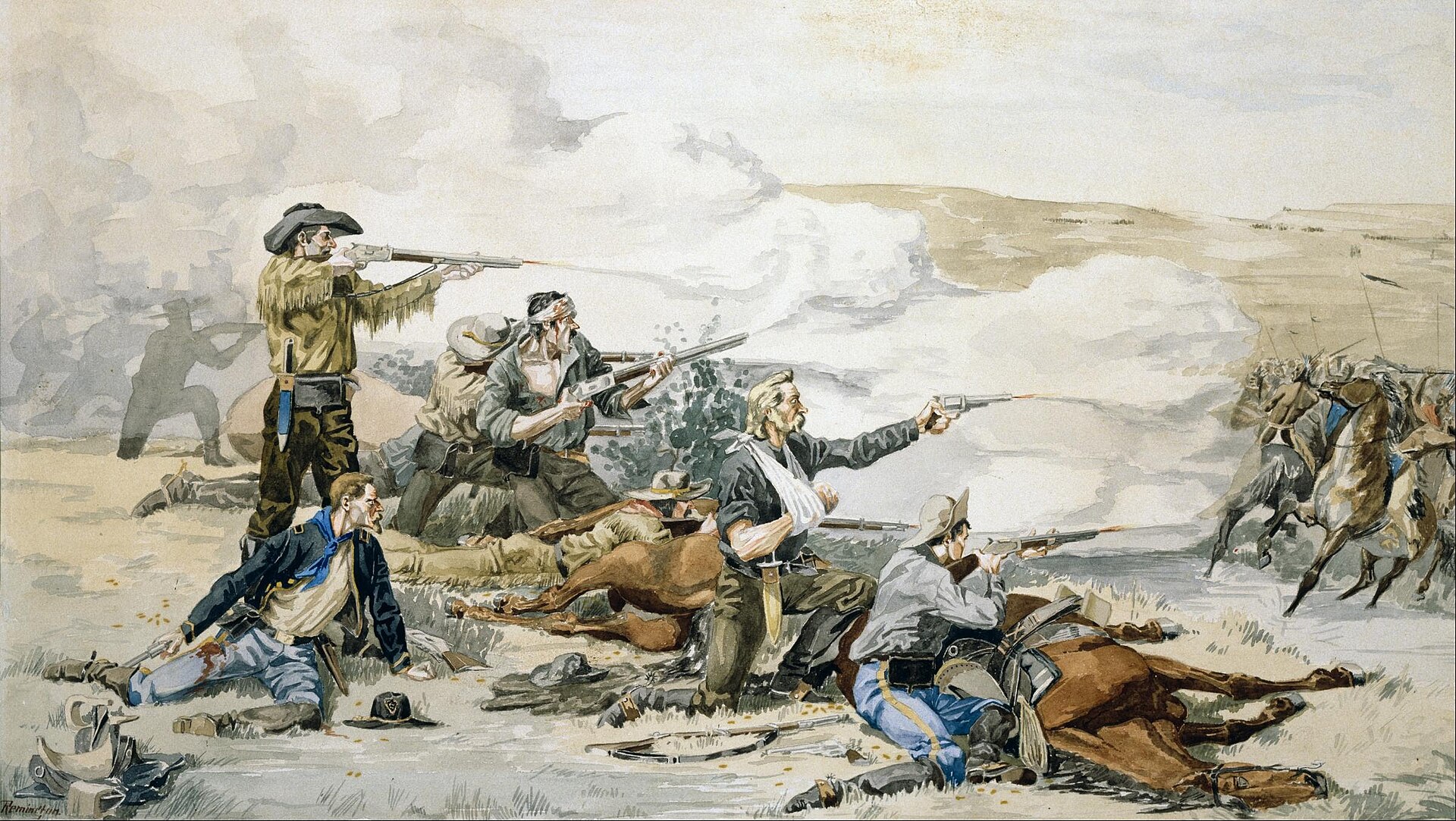
Combatants
Historians still argue over how many Native fighters took part in this conflict, with figures proposed anywhere from 900 to 4,000 warriors. During the 1870s the seven bands making up the Lakota Sioux totaled roughly 15,000 people counting men, women, and children together, though the bulk of that population stayed on the Great Sioux Reservation and took no part in the fighting. Back in November 1875, an Indian agent described those living outside reservation boundaries, in the unceded lands, as numbering only "a few hundred warriors." Crook, for his part, calculated that he could potentially confront as many as 2,000 fighters. The Sioux who held their ground in the unceded territory where combat would unfold were mostly Oglala and Hunkpapa people, roughly 5,500 strong. Joining them were approximately 1,500 Northern Cheyenne and Arapaho, bringing the entire hostile population to somewhere near 7,000 souls, among whom perhaps 2,000 could be counted as warriors. As for the Little Bighorn fight specifically, estimates of warrior participation range from 900 to 2,000.
While Native forces held real advantages through their mobility and familiarity with the terrain, none of these men were full-time soldiers. Springtime left them somewhat immobile, since their horses emerged weak from a winter of scarce forage. Then much of the warm months, through summer and into fall, were consumed by buffalo hunting to keep their families fed. Roughly half carried firearms, everything from modern repeating rifles down to outdated muskets, while the other half relied on bows and arrows. Their bows, short and sturdy, worked well on horseback and could kill effectively up close, yet proved nearly useless against enemies at a distance or behind fortifications. Ammunition, moreover, remained scarce. Traditionally, warriors fought to earn personal glory rather than to achieve any broader military goal, though Crazy Horse apparently managed to instill some notion of united purpose among the Sioux. Of all the Plains peoples, the Cheyenne stood out as the most unified and organized. Adding further strain, the Sioux and Cheyenne were simultaneously waging war against longstanding rivals, the Crow and Shoshone, which siphoned away considerable resources from their fight against the army.
On the American side, the military responded by building a network of forts encircling both the Great Sioux Reservation and the unceded territory beyond it. By summer 1876 the largest concentration of troops assembled against the Indians at any single point reached 2,500 soldiers stationed in the unceded lands, supported by hundreds of scouts and civilian personnel. A great many of these troops were newly arrived immigrants who lacked seasoning in frontier conditions or in fighting Indians. For weaponry, the cavalry carried .45 caliber single-action revolvers alongside the Springfield model 1873, a breech-loading single-shot rifle that gave the troops considerably longer range than most weapons available to their Indian opponents.
Reynolds' campaign
General Crook wasted no time moving against the enemy, opening the offensive even as Terry hesitated. He sent Colonel Joseph J. Reynolds ahead with six cavalry companies, and Reynolds's men found an encampment of roughly 65 lodges, striking it at dawn on March 17, 1876. Crook rode along with this force but left the actual direction of the assault to others. Reynolds's soldiers seized the camp at first and set it ablaze, only to be driven back soon after by defenders firing on them. Because several men were abandoned on the field during the withdrawal, Reynolds later faced court-martial proceedings over the incident. Although the pony herd belonging to the band fell into American hands, the Lakota managed to reclaim most of the animals in a counterraid the next day. Army commanders were convinced at the time that Crazy Horse had been their target, but the camp actually belonged to Northern Cheyenne under Old Bear, Two Moons, and White Bull, along with a small number of Oglala led by He Dog.
Aftermath
The closing chapter of the 1876-77 conflict looked quite different from what unfolded during Red Cloud's War a decade before it. In the 1860s, Lakota bands rallied behind their leaders with broad enthusiasm for the campaign. The situation in 1876-77 told another story, since roughly two-thirds of the Lakota population had already taken up residence at Indian agencies, relying on government rations for their livelihood. These agency bands stayed out of the conflict entirely, offering neither manpower nor backing to those who fought.
The rift this created among the Lakota did not heal quickly, and it shaped tribal politics for decades after the reservation era began. When the Ghost Dance movement emerged in 1889-90, it drew the bulk of its adherents from those who had never settled at the agencies and had instead taken part in the earlier war.
Although the Lakota outnumbered their allies considerably, their bands operated with a good deal of autonomy, each reaching its own conclusions about whether to fight. Still, numerous bands formed alliances with the Cheyenne, and intermarriage between the two peoples was common. Some have argued that Plains Indians themselves regarded the 1876-77 conflict less as a Sioux war and more as "The Great Cheyenne War."
Written by Aubrey Research from Great Sioux War of 1876 on Wikipedia, cited as a reference and not reproduced.
Where these engagements were fought
All 9 are placed on the map. Select a marker to see the engagement.
Red markers are surveyed battlefields with a mapped boundary; navy markers are point-located engagements. Select a marker to open its page.
Documented engagements
| Engagement | State | Year | Outcome | Forces or losses |
|---|---|---|---|---|
| Battle of Cedar Creek | MT | 1876 | United States tactical victory | 6 bodies recovered; unknown wounded vs 2 killed; 2 wounded |
| Dull Knife Fight | WY | 1876 | United States victory | 40 killed; Unknown wounded vs 7 killed; 26 wounded |
| Battle of Powder River | MT | 1876 | Northern Cheyenne/Oglala Lakota victory | 3 killed, several people later died of exposure; 3 wounded… |
| Slim Buttes | SD | 1876 | United States victory | 3 killed; 14 wounded |
| Battle of Warbonnet Creek | NE | 1876 | United States victory | 1 killed; Unknown wounded vs None |
| Battle of the Rosebud | MT | 1876 | Lakota and Cheyenne victory | 13-36 killed ; 63-100 wounded vs U.S.: 14-28 killed; 43-46… |
| Wolf Mountains | MT | 1877 | American victory | 3 killed; 8 wounded |
| Battle of the Little Bighorn | MT | 1876 | Lakota, Northern Cheyenne, and Arapaho victory | 1,100-2,500 warriors vs c. 700 cavalrymen and scouts |
Plus 1 further documented engagement in the Great Sioux War of 1876 record.
By state
Engagements and locations are compiled from published sources: U.S. Adjutant-General's Office, Chronological List of Actions with Indians (1891) (public domain (U.S. federal record)); Wikidata (structured data, CC0).