West of the Mississippi (1804-1924)
The struggle between Native peoples, settlers, and federal troops across the western states falls under the broad label of the Indian Wars. Most of this fighting took place during and after the Civil War, ending roughly at the frontier's close near 1890, though areas settled earlier such as Texas, New Mexico, Utah, Oregon, California, and Washington experienced heavy fighting well before 1860.
Historians have tried to quantify the human toll. Gregory Michno compiled figures tied directly to specific engagements and found that out of 21,586 total casualties counted for 1850 through 1890, military personnel and civilians made up 6,596, or 31 percent, while Indian losses reached about 14,990, or 69 percent. Michno cautioned that he relied on army estimates in nearly every instance, meaning his numbers skew toward the military's own accounting. He also acknowledged that his research barely touches on Indian war parties and that army records themselves are frequently incomplete.
Michno's data further shows that states bordering Mexico saw more fighting than interior regions. Arizona topped the list, with 310 documented battles occurring within its borders, and it also led all states in war-related deaths, with at least 4,340 people killed among settlers and Indians combined, more than double the toll in Texas, which ranked second. Fifty-one percent of all battles between 1850 and 1890 occurred in Arizona, Texas, and New Mexico alone, accounting for 37 percent of casualties across the entire region west of the Mississippi.
Settlers and trappers pushing into western territory established routes like the Santa Fe Trail and the Oregon Trail, and for a time relations with Indian peoples along these corridors stayed largely amicable. The Bent family, operating out of Bent's Fort on the Santa Fe Trail, maintained cordial ties with the Cheyenne and Arapaho. Along the Oregon Trail, the 1851 Treaty of Fort Laramie between the United States and Plains tribes as well as Indians from the northern Rockies secured passage rights for settlers, permission to build roads, and the stationing of troops.
Everything changed with the 1859 Pike's Peak Gold Rush, which brought a wave of white settlement to the Front Range, sustained by trade routes crossing the central plains. The Homestead Act of 1862 and the postwar expansion of transcontinental railroads pushed settlement even further, putting white newcomers in direct competition with Indians over land and resources throughout the Great Plains and Rocky Mountain region. Gold strikes in Montana between 1862 and 1863, along with the opening of the Bozeman Trail, sparked Red Cloud's War, while a later gold rush in the Black Hills from 1875 to 1878 triggered the Great Sioux War of 1876 and 1877.
As miners, ranchers, and settlers pushed across the plains, clashes with Indian communities multiplied. Numerous tribes, from the Utes in the Great Basin to the Nez Perce in Idaho, took up arms against American expansion at various points, but it was the Sioux of the northern plains and the Apaches in the Southwest who fought most fiercely, under determined leaders such as Red Cloud and Crazy Horse. Notably, the Sioux were newcomers to the plains themselves, having once been settled farmers around the Great Lakes before migrating west and displacing other tribes to become formidable fighters. The Apaches, meanwhile, built raiding into their economy and fought partly to avenge fallen relatives.
When the Civil War drew regular Army units eastward, volunteer infantry and cavalry raised by California, Oregon, various territorial governments, and local militias filled the gap. These forces battled Indians, kept communication lines with the East open, secured the West for the Union, and turned back a Confederate bid to seize New Mexico Territory. After 1865, federal policy demanded that Indians either assimilate as citizens or settle peacefully on reservations; intertribal raiding and warfare were forbidden, and the Army bore responsibility for rounding up any armed bands found off reservation land.
In Texas, the eighteenth and early nineteenth centuries brought sustained conflict between the Comanches, dominant in the north and west, and Spanish settlements to the south and east. At the 1759 Battle of the Twin Villages, Comanche fighters and their Wichita allies routed a Spanish and Apache force exceeding 500 men, halting further Spanish expansion. For roughly seventy years afterward, Comanche raids against Spanish settlements
Written by Aubrey Research from American Indian Wars on Wikipedia, cited as a reference and not reproduced.
Where the fighting fell
The Indian Wars were fought across the West. Each state carries its own record of engagements. Select a state to see them.
The major wars
Most engagements in the register are individual actions, never grouped under a war in the source. Where the record does place a battle in a named campaign, it is gathered here. These hubs cover the best-documented wars, not the whole period.
By decade
The tempo of the Indian Wars, 1860s to 1890s. Select a decade to see its engagements.
Notable engagements
| Engagement | State | Year | Outcome | Forces or losses |
|---|---|---|---|---|
| Skirmish, Fort Buchanan | AZ | 1865 | Apache victory | 1 killed; 1 wounded; 1 fort destroyed vs ~2 killed |
| Hayfield Fight | MT | 1867 | U.S. victory | 3 killed; 4 wounded vs Unknown: estimates from 8 to 23… |
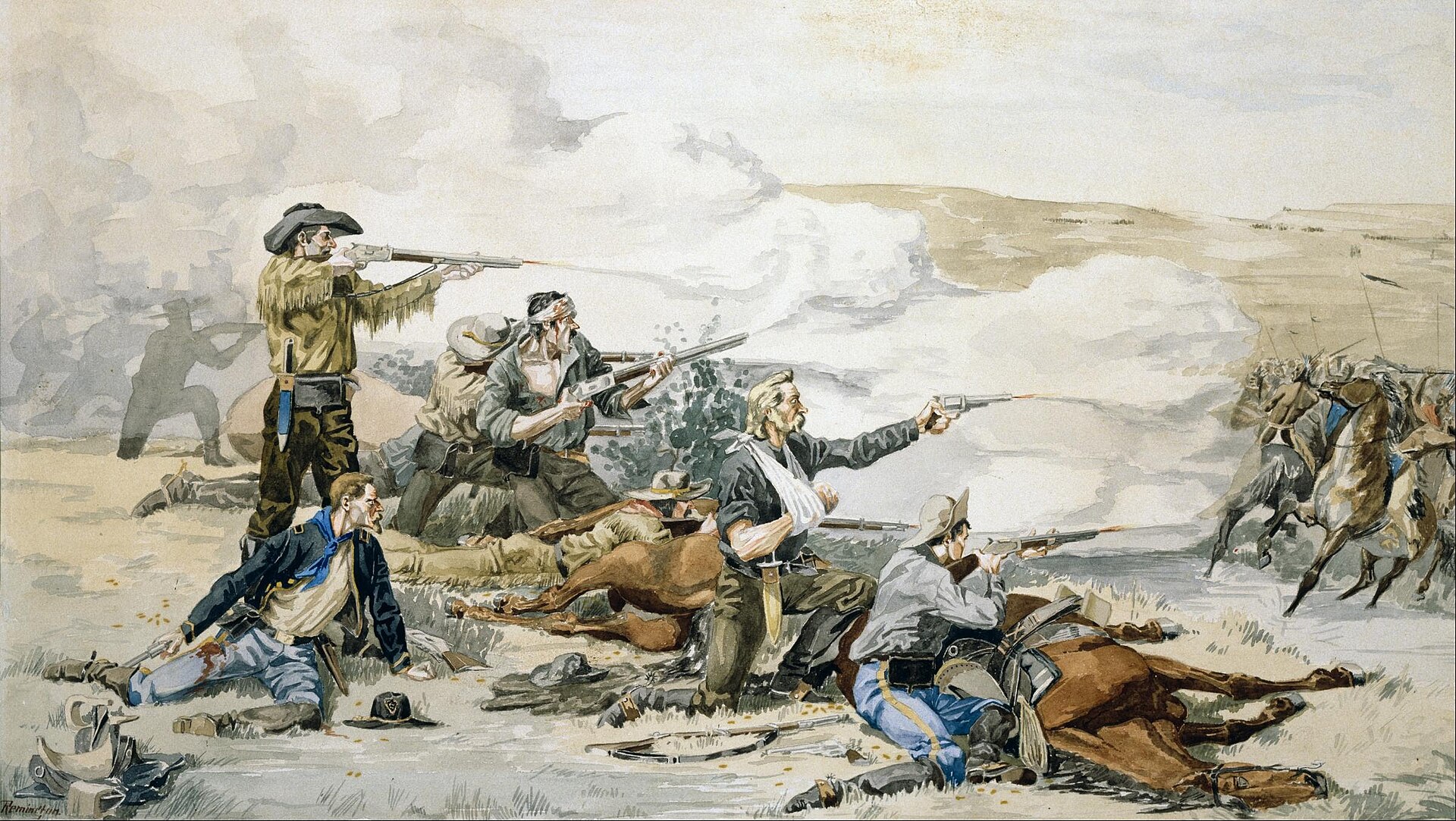
| Battle of Beecher Island | CO | 1868 | United States victory | 6 killed; 15 wounded vs 9-32 killed |
| Saline River | KS | 1868 | Inconclusive | 1 killed; several wounded; 6 cases of cholera vs 6 killed… |
| Summit Springs | CO | 1869 | United States victory | 1 wounded; 52 Indians killed; 15 Indians captured |
| Battle of Blanco Canyon | TX | 1871 | Inconclusive | 1 dead, 2 reported wounded, including Col. Mackenzie. vs 5 |
| Battle of Salt River Canyon | AZ | 1872 | United States victory | 1 killed vs 76 killed; 34 captured |
| Battle of Lost River | OR | 1872 | United States victory | 1 killed, 7 wounded vs 2 killed, 3 wounded |
| Battle of Dry Lake | CA | 1873 | United States victory | 5 warriors killed vs 5 killed; 8 wounded |
| First Battle of the Stronghold | CA | 1873 | Modoc victory | None vs 42 killed, many wounded |
| Battle of Honsinger Bluff | MT | 1873 | Inconclusive | 3 wounded vs 3 killed, 1 wounded |
| Battle of Sand Butte | CA | 1873 | Modoc victory | None vs 35 casualties |
Plus 847 further documented engagements in the the American West record.
Engagements and locations are compiled from published sources: U.S. Adjutant-General's Office, Chronological List of Actions with Indians (1891) (public domain (U.S. federal record)); Sheridan, Record of Engagements with Hostile Indians (1882) (public domain); Wikidata (structured data, CC0); Wikipedia (text rewritten and cited as a reference, CC BY-SA 4.0).