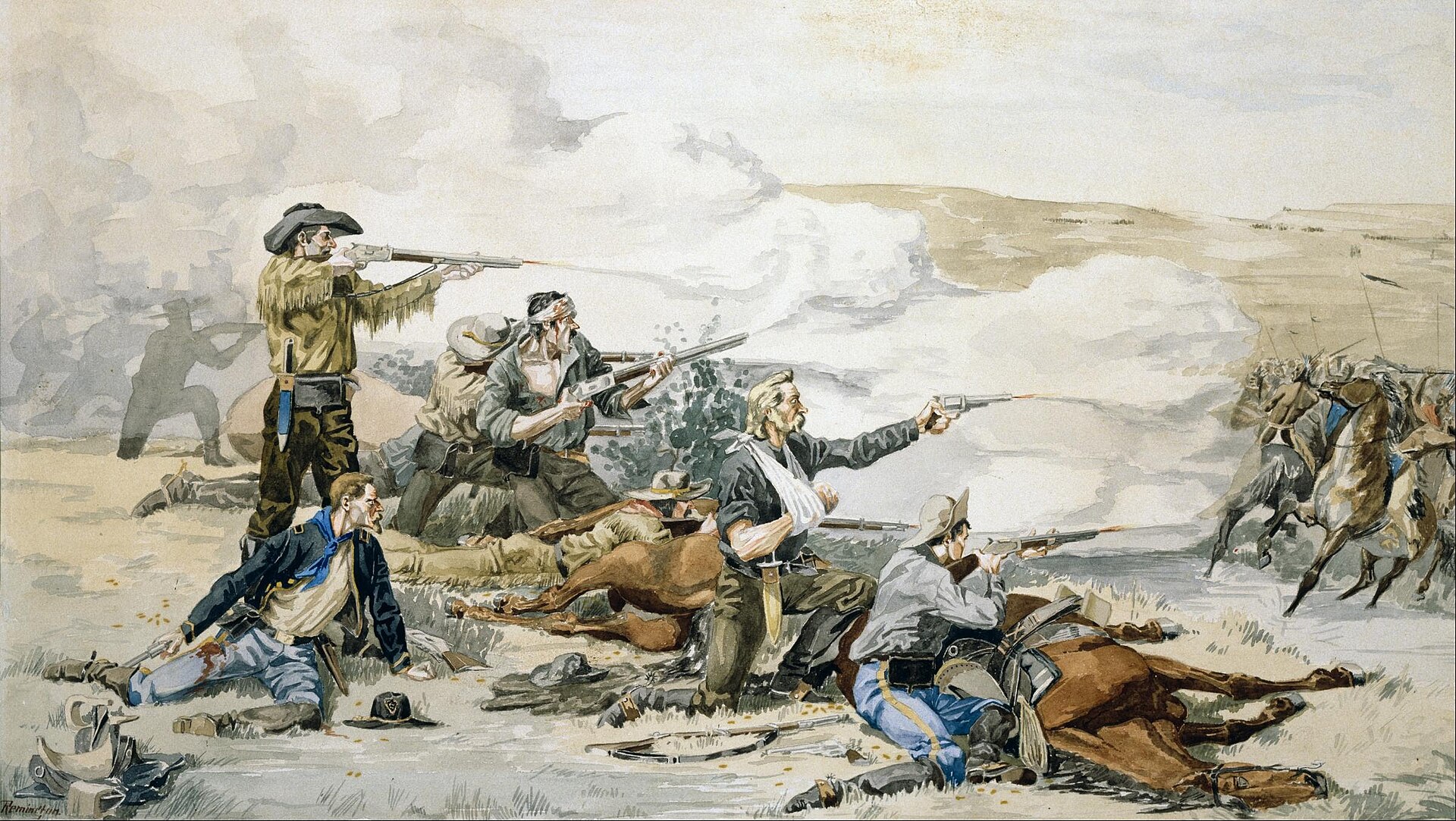
Between 1849 and 1886, the United States Army clashed repeatedly with several Apache tribal confederations across the southwestern territories, a struggle now remembered collectively as the Apache Wars, though scattered outbreaks of violence persisted all the way to 1924. These hostilities had their roots in the aftermath of the Mexican-American War, when victory in 1846 allowed the United States to absorb disputed land from Mexico, ground that was already home to both settlers and Apache communities. Friction only deepened as American newcomers pushed into areas long claimed by Apache peoples in order to farm, graze livestock, and dig for minerals.
To counter Apache raiding parties and compel tribes onto reservations set aside under the Indian Removal Act, the Army built a network of forts throughout the region. Not every reservation, however, sat on land the Apache had traditionally inhabited. Matters came to a head in 1886, when the Army deployed more than 5,000 troops to the field, a campaign that ended with Geronimo and thirty of his followers laying down arms. Most historians mark this surrender as the close of the Apache Wars, even though friction between settlers and Apache groups did not fully disappear. Notably, Confederate forces had entered the fighting briefly in Texas during the early 1860s, only to be pulled away toward the Civil War fronts in New Mexico and Arizona.
Background
For generations before contact with the United States military, Apache groups had conducted raids against rival tribes, and on occasion against one another, seeking livestock, food, or captives. These actions typically involved small bands acting toward a particular goal rather than large-scale mobilization. Only rarely did the Apache draw together every able warrior across the tribe to form fighting forces numbering in the hundreds. It was in 1849 that the Army launched its earliest campaigns aimed directly at the Apache.
Conflicts
When the Mexican-American War broke out in 1846, numerous Apache leaders assured American troops they could pass safely through Apache lands, even as other bands took up arms on behalf of Mexico and against the tide of settlers moving into New Mexico. Once the United States took possession of Mexico's northern territories in 1848, Mangas Coloradas agreed to a peace treaty, acknowledging the Americans as the new masters of land wrested from Mexican hands.
Yet the agreement reached at Santa Fe on April 2, 1851 proved fragile from the start. Tiller notes that the Jicarillas were bound to honor its terms at once, while the new Mexicans considered themselves obligated only once Congress had given its approval. That approval never came; the treaty was left unratified by the United States Congress. For a time an uneasy calm held between the Apache and the Americans, but it broke down once prospectors began pouring into the Santa Rita Mountains of what is now Arizona, setting the stage for renewed fighting.
The trouble known as the Jicarilla War erupted in 1849, when settlers in the northeastern part of New Mexico were set upon and killed by a combined force of Jicarillas and Utes. A further killing took place in 1850, this time claiming the lives of several mail carriers. By 1853 the U.S. Army had entered the fray directly, going on to clash with Apache forces first at the Battle of Cieneguilla, where the Apache carried the day, and afterward at the Battle of Ojo Caliente Canyon, which ended in an American triumph.
He left his men in no doubt about his fury, snarling that the old murderer had slipped past every soldier command sent after him and had strung a trail of blood across 500 miles along the old stage line, and demanding the man dead by the next morning, asking twice if they understood.
Nine more years of fighting followed, as the Apaches pressed their struggle even harder to avenge the memory of Mangas Coloradas.
Colonel Carleton eventually settled on a plan to relocate the Navajo and Apache onto reservations. His original aim had simply been to make travel through the Rio Grande valley less dangerous and put a stop to attacks on settlers, so he started by herding several Mescalero and Navajo groups onto the reservation land at Fort Sumner. To carry this out, he turned to Kit Carson, once a friend to the Navajo, who forced their surrender by wiping out their fields and herds and then marched them on the Long Walk to Fort Sumner.
One of the largest engagements of the entire American Indian Wars unfolded on November 25, 1864, when the Plains Apache took part in the First Battle of Adobe Walls. Carson had marched into the Texas panhandle at the head of 400 soldiers and Ute scouts, seizing a camp whose occupants had already fled. In response, more than 1,000 warriors drawn from the Comanche, Kiowa, and Plains Apache descended upon his force. Taking cover in a deserted adobe structure atop a rise, Carson held off wave after wave of assaults. By the close of a full day's fighting he chose to withdraw, and the Indians let him go without further resistance. Among the dead was Iron Shirt, a Plains Apache chief, while six of Carson's soldiers lost their lives; army estimates placed Indian losses at 60 killed and wounded.
Fighting between Apaches and the U.S. Military in Texas came to a close with two clashes in the summer of 1880, the Battle of Rattlesnake Springs and the Battle of Quitman Canyon. The final Apache incursion into the state to be thoroughly documented was the McLaurin Massacre of 1881, though it is thought that raids may have continued there as late as 1882.
Fighting between American forces and the Yavapai and Tonto peoples in Arizona became known collectively as the Yavapai Wars, sometimes called the Tonto Wars. Hostilities stretched back to at least 1861, when settlers from the United States began pushing into territory the Yavapai and Tonto called home. During this era, observers classified the Yavapai as part of the Western Apache, largely due to their strong ties to groups like the Tonto and Pinal. The conflict finally came to a close when the Yavapai were forced from Camp Verde Reservation and marched to San Carlos on February 27, 1875, a forced relocation that later generations would remember as Exodus Day.
Years earlier, in 1871, an armed party made up of six white Americans, forty-eight Mexicans, and nearly one hundred Papago fighters descended on Camp Grant, slaughtering roughly 150 Apache men, women, and children in what became known as a massacre. Military operations against the Apache did not end there, continuing well into the mid-1870s. Clashes such as those at Salt River Canyon and Turret Peak stand out as stark illustrations of how brutal the fighting in Arizona had become. Both army units and armed civilians, particularly those coming out of Tucson, kept up relentless pursuit of Apache raiding parties in hopes of finally putting a stop to their attacks.
Facing the prospect of being pushed off their homeland at Ojo Caliente, New Mexico and forced onto the San Carlos Apache Indian Reservation in Arizona, the seasoned Chiricahua war chief Victorio and his people chose resistance in 1879. On August 21 of that year, he broke away from the reservation together with 80 warriors along with their women and children. His ranks swelled as other Apache, particularly Mescalero fighters, rallied to his side, eventually bringing his total strength to as many as 200 warriors, a remarkably large gathering by Apache standards.
What followed was more than a year of guerrilla warfare, as Victorio waged conflict against the Army and white settlers across southern New Mexico, western Texas, and into northern Mexico. Over the course of this campaign he engaged in upward of a dozen clashes with military forces while also striking at civilian settlements. Thousands of American and Mexican troops, aided by Indian scouts, hunted him relentlessly as he moved between various strongholds to evade capture.
His campaign came to a violent close on October 14, 1880, when Mexican forces trapped him and a number of his followers at Tres Castillos in Chihuahua, Mexico, killing them all. Yet the fight did not end there, as his subordinate Nana took up the struggle. Commanding fewer than 40 warriors, Nana carried out a wide-ranging series of raids through New Mexico between June and August of 1881. He lived through this campaign and eventually died of old age in 1896.
In August 1881 troops from the Fort Apache Indian Reservation moved out to look into fresh word of Apache restlessness and to seize the medicine man Nock-ay-det-klinne. Three Native scouts carried out the arrest without incident, but trouble arose as they headed back toward camp. When they reached it on August 31, they found the site already ringed by Nock-ay-det-klinne's followers. This touched off the Battle of Cibecue Creek, in the course of which Nock-ay-det-klinne lost his life. The next day, Apache fighters struck at Fort Apache to avenge his killing.
By the spring of 1882, a warrior named Na-tio-tisha had assembled roughly sixty White Mountain Apache men under his leadership. Early that July this band ambushed a group of San Carlos policemen, killing four of them, among them the chief of police. Following this strike, Na-tio-tisha guided his fighters northwest into the Tonto Basin, setting off deep unease among Arizona's settlers, who pressed the Army for protection. In response, fourteen cavalry companies were dispatched from forts throughout the region. By mid-July, Na-tio-tisha had moved his party up Cherry Creek toward the Mogollon Rim, aiming for General Springs, a known watering spot along the Crook Trail. Realizing a single cavalry troop was on their trail, the Apaches set an ambush about seven miles north of General Springs, at a point where a branch of East Clear Creek carves a gorge through the rim. They took cover on the opposite side and waited for the soldiers to appear. Captain Adna Chaffee commanded the pursuing company, but chief scout Al Sieber spotted the ambush beforehand and alerted the men in time. Overnight, four additional companies from Fort Apache, under Major A.W. Evans, joined Chaffee's troop, and together they moved to open what would become the Battle of Big Dry Wash.
Written by Aubrey Research from Apache Wars on Wikipedia, cited as a reference and not reproduced.
Where these engagements were fought
7 of the 8 could be placed to a location and appear on the map; the remaining 1 are recorded without a precise point. Select a marker to see the engagement.
Red markers are surveyed battlefields with a mapped boundary; navy markers are point-located engagements. Select a marker to open its page.
Documented engagements
| Engagement | State | Year | Outcome | Forces or losses |
|---|---|---|---|---|
| Battle of Salt River Canyon | AZ | 1872 | United States victory | 1 killed vs 76 killed; 34 captured |
| Battle of Yellow House Canyon | TX | 1877 | Comanche/Apache victory | 12 killed; 8 wounded vs 21 killed; 22 wounded |
| Battle of Hembrillo Basin | NM | 1880 | Apache victory | 2 killed; 5 wounded vs Perhaps 3 dead |
| Battle of Cibecue Creek | AZ | 1881 | Apache strategic victory | 8 killed; 2 wounded vs 18 killed |
| Battle of Big Dry Wash | AZ | 1882 | United States victory | 20 killed vs 2 killed; 6 wounded |
| Carrizo Canyon | NM | 1881 | 2 killed; 3 wounded; 4 Indians killed | |
| Devil's Creek, Mogollon Mountains | NM | 1885 | 4 wounded | |
| Little Dry Creek | NM | 1885 | 5 killed; 2 wounded |
By state
Engagements and locations are compiled from published sources: U.S. Adjutant-General's Office, Chronological List of Actions with Indians (1891) (public domain (U.S. federal record)); Wikidata (structured data, CC0).