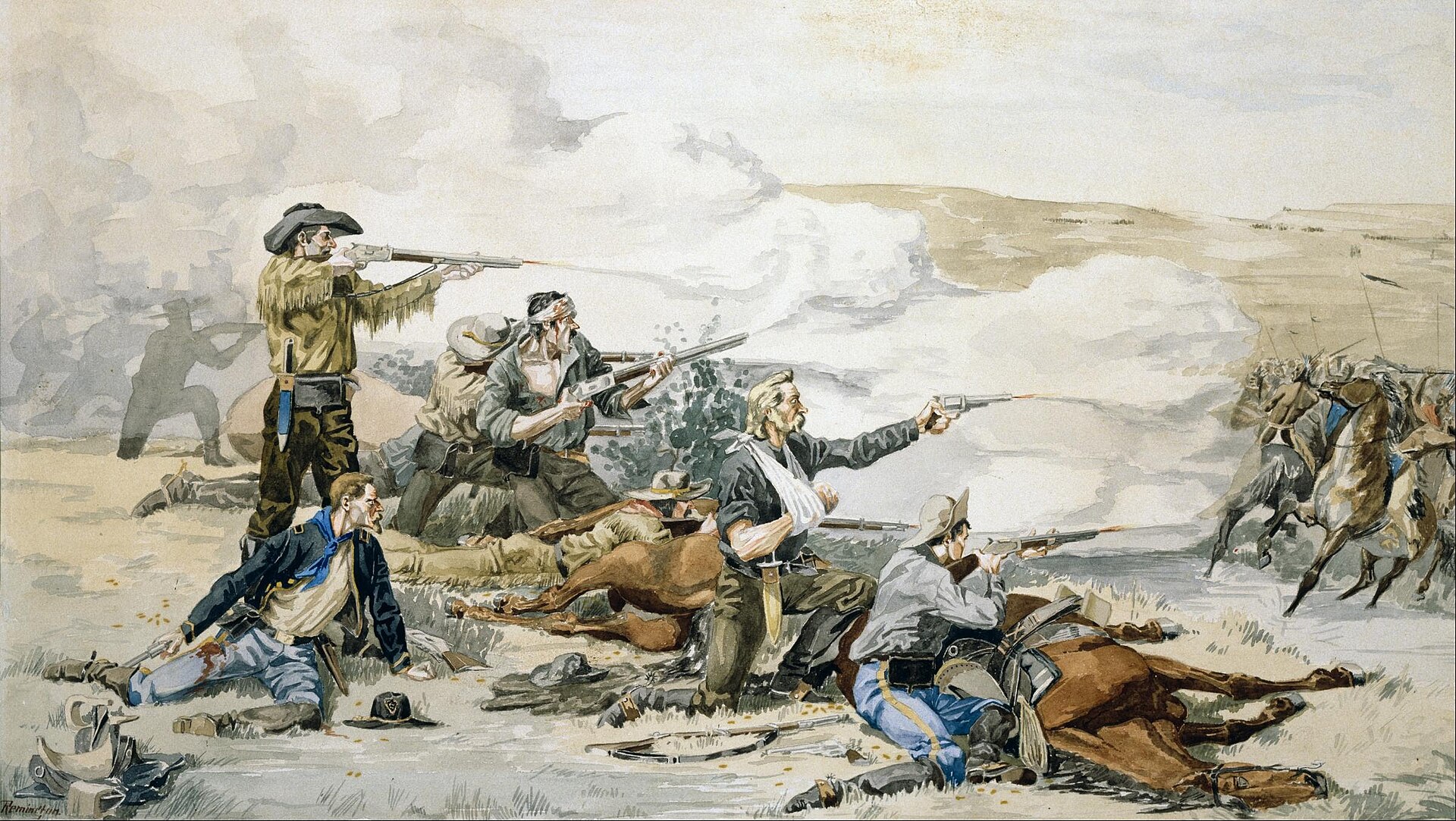
In 1874 the United States Army set out on a campaign known as the Red River War, aiming to push the Comanche, Kiowa, Southern Cheyenne, and Arapaho off the Southern Plains and drive them onto reservations in Indian Territory. Multiple army columns swept back and forth across the Texas Panhandle, seeking to track down, wear out, and seize roaming Native American groups. Nearly all the resulting fights were minor skirmishes producing light losses on both sides. As 1874 drew toward its close, the conflict gradually faded, since an ever-shrinking number of Indian bands still had the resources and endurance needed to keep operating in the field. Although one sizable group held out until it finally gave up in mid-1875, this campaign effectively closed the era of free-roaming Indian life on the southern Great Plains.
War
During that same winter a man named Isatai'i rose to prominence as a spiritual figure among the Quahadi Band of Comanches. He insisted he possessed the ability to make himself and his followers impervious to harm from their foes, bullets included, and this claim allowed him to draw together a vast number of warriors for major raiding parties. At the same time, the internal politics of the Kiowa underwent a change, as the faction favoring war, guided by the principal chief Guipago (also rendered Gui-pah-gho, and referred to by present day writers as Lone Wolf "the Elder" so as not to confuse him with Mamay-dayte, who would later be called Lone Wolf "the Younger"), gained more sway than it had previously enjoyed.
On June 27, 1874, Isa-tai'i joined forces with Quanah Parker, the Comanche chief, to lead roughly 250 warriors against a modest buffalo hunters' outpost in the Texas Panhandle known as Adobe Walls. The place amounted to little more than a handful of structures, home to just 28 men and a single woman at the time. Some whites fell in the initial moments of what became known as the Second Battle of Adobe Walls, yet most managed to seal themselves inside and repel the assault. Armed with large-caliber buffalo guns capable of striking from distances far beyond what the attackers anticipated, the hunters turned back the assault entirely.
Texas saw another clash, this one involving the Kiowa. In July, warriors under Lone Wolf struck a patrol of Texas Rangers. Casualties from this skirmish, remembered as the Lost Valley fight, stayed low on both sides, though the incident heightened frontier anxieties and prompted the Army toward harsher measures.
Government officials had not anticipated this surge of violence. Grant's so-called peace policy was judged to have failed, clearing the way for the Army to receive authorization to bring the southern Plains tribes under control by any means necessary. At that point, roughly 1,800 Cheyennes, 2,000 Comanches, and 1,000 Kiowas still remained beyond government control, together fielding some 1,200 warriors.
Five separate military columns received orders from General Philip Sheridan to close in on the broader Texas Panhandle region, with particular focus on the Red River's upper tributaries. His intent was straightforward: leave the Indians nowhere safe to hide and keep up relentless pressure until they had no choice but to settle permanently on reservations.
Colonel Ranald S. Mackenzie held command over three of these five forces. From Fort Sill, Lieutenant Colonel John W. Davidson led the Tenth Cavalry on a direct westward march. Meanwhile, Lieutenant Colonel George P. Buell brought the Eleventh Infantry northwest out of Fort Griffin. Mackenzie personally guided the Fourth Cavalry on a northern route starting at Fort Concho.
Colonel Nelson A. Miles headed the fourth column, made up of the Sixth Cavalry alongside the Fifth Infantry, pushing southward from Fort Dodge. Major William R. Price commanded the fifth and final group, the Eighth Cavalry, numbering 225 officers and enlisted men in total, supplemented by six Indian scouts and a pair of guides. This force set out from Fort Union and traveled eastward by way of Fort Bascom in New Mexico. Under the overall plan, these converging forces were meant to keep pressing forward without pause until they had thoroughly crushed Indian resistance.
Fighting broke out repeatedly across the region, with as many as twenty separate clashes occurring throughout the Texas Panhandle. Made up wholly of troops and their scouts, the Army pursued every possible chance to confront the Indians directly. For their part, the Indians, burdened with women, children, and elders, generally worked to steer clear of such confrontations. On those occasions when the two sides crossed paths, the Indians typically chose flight over the risk of forced surrender. Yet even a clean getaway could prove ruinous, since escaping often meant abandoning horses, provisions, and gear along the way. The Army held a distinct advantage here, drawing on what amounted to inexhaustible supplies and equipment; soldiers and their Indian scouts routinely torched whatever they seized from fleeing bands, and this let them sustain operations without any real limit. Hostilities dragged on through the autumn months of 1874, though as time passed more and more Indians found themselves compelled to surrender and make their way to Fort Sill, entering the reservation system there.
Captain Wyllys Lyman set out on September 9, 1874, guiding a supply train loaded with provisions bound for Camp Supply in the Indian Territory, meant to sustain Col. Nelson A. Miles' command. Along the way, a band of Comanches and Kiowas confronted the train. What followed was a fierce clash in which Lyman, commanding 95 men, arranged the wagons into a defensive corral and repelled roughly 400 opponents. A scout managed to slip away during the fighting to carry news of their plight back to Camp Supply.
Word reached the Sixth Cavalry, which set out at once, pushing through a rainstorm without pause for rest to reach the besieged train. By the time they arrived on September 14, the attacking force had already withdrawn.
This engagement stretched on longer than any other of the War and drew more public attention than almost any other clash of the conflict. History remembers it under two names: the Battle of the Upper Washita River and the Battle of Lyman's Wagon Train.
In the opening days of September, Tonkawa and Black Seminole Scouts riding ahead of the Fourth Cavalry ran into a Comanche ambush near the Staked Plains, narrowly getting away with their lives intact. Despite the close call, the scouts managed to pinpoint where the Comanche were positioned and passed this intelligence on to Col. Mackenzie.
The Army's greatest triumph unfolded after Mackenzie's scouts located a sprawling encampment shared by Comanche, Kiowa, and Cheyenne people, situated in the upper reaches of Palo Duro Canyon along with their horses and stores of food meant to last the winter. Mackenzie's men launched their assault at first light on September 28, descending a sheer canyon wall to reach their targets. Caught off guard, the Native Americans had no chance to round up their mounts or belongings before being forced to flee. Sergeant John Charlton later set down his own account of what happened that day:
For a while the warriors stood firm, buying time so that the women and horses could get away, but the soldiers kept up a steady fire and eventually pushed the defenders into retreat.
Indian losses in the fighting itself were light, with only four killed, yet the consequences proved far more severe. Mackenzie's command put more than 450 lodges to the torch and wiped out huge stores of buffalo meat. In addition, they captured some 1,400 horses, and afterward shot down most of the herd so that the Indians could not steal them back.
Aside from its exceptional scale, what happened at Palo Duro Canyon mirrored the broader pattern of the conflict. In most clashes, deaths on either side were minimal or nonexistent, yet for the Indians the steady drain of supplies and horses was a burden they could not sustain. A band left without mounts and short on ways to feed itself, even after slipping free of danger, was usually left with little choice but to surrender and move onto the reservation.
Aftermath
By June 1875 the conflict had run its course, formally closing when Quanah Parker led his Quahadi Comanche band into Fort Sill to give themselves up, the last sizable group of free-roaming Indians in the southwest. Together with the near total destruction of the buffalo herds, this surrender cleared the way for farmers and ranchers to move permanently into the Texas Panhandle. The Southern Plains tribes, once formidable, suffered their last military setback here, and the fighting marked the close of the broader Texas-Indian conflicts.
Once hostilities ceased, Sheridan and Sherman pushed for many of those captured to face execution before military tribunals. The officer tasked with handling the prosecutions determined, however, that no formal "state of war" had ever existed, which stripped such tribunals of any legal footing. Sherman turned instead to exile as a solution, and with Grant's support he arranged for 71 prisoners to be sent to a Florida prison, where they were meant to remain confined for the rest of their lives.
Written by Aubrey Research from Red River War on Wikipedia, cited as a reference and not reproduced.
Where these engagements were fought
All 4 are placed on the map. Select a marker to see the engagement.
Red markers are surveyed battlefields with a mapped boundary; navy markers are point-located engagements. Select a marker to open its page.
Documented engagements
| Engagement | State | Year | Outcome | Forces or losses |
|---|---|---|---|---|
| Battle of Beecher Island | CO | 1868 | United States victory | 6 killed; 15 wounded vs 9-32 killed |
| Battle of Palo Duro Canyon | TX | 1874 | United States victory | 1 wounded vs 15 killed at Tule; 50-60 killed at Palo Duro |
| Second Battle of Adobe Walls | TX | 1874 | U.S. victory | 4 killed, unknown wounded vs Estimated 30 killed, unknown… |
| Battle of Washita River | OK | 1868 | 21 killed and 13 wounded vs Range of military and civilian… |
By state
Engagements and locations are compiled from published sources: Wikidata (structured data, CC0).