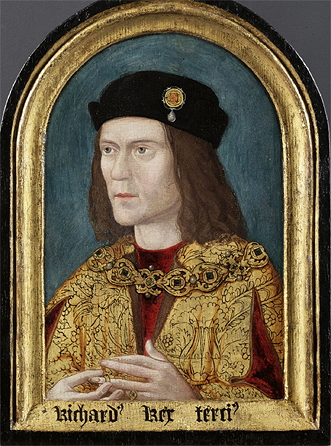
Unknown artist, c. 1510–1520 / Wikimedia Commons / Public domain
History & Significance
The Battle of Bosworth Field, fought on 22 August 1485 across the marshy ground of Redemore Plain in west Leicestershire, ended the Plantagenet dynasty and made Henry Tudor the first king of a line that would transform England. Richard III, who had ruled for two years, led a cavalry charge that morning towards the claimant Henry's position across ground that proved disastrously soft. Within a matter of minutes Richard was dead — the last English king to be killed in battle. Tradition holds that his crown, knocked from his helmet in the fighting, was found in a hawthorn bush on the field and carried up the hill above Stoke Golding to be placed on Henry's head. A single afternoon in a Midlands vale ended five generations of Plantagenet kingship and began the Tudor century.
The significance of Bosworth extended far beyond the dynastic change it effected. Richard's death closed the long period of Yorkist and Lancastrian conflict — the Wars of the Roses — that had destabilised the English crown since 1455. Henry VII, who proved a cautious and methodical administrator, systematically dismantled the power of the great noble houses that had made and unmade kings for three decades. He married Elizabeth of York, uniting the two claims. The Tudor state that emerged from Bosworth was, by the mid-sixteenth century, more centralised, more capable of projecting royal authority, and more comprehensively governed than anything medieval England had produced. The battle was the hinge on which the medieval and early modern periods turned.
For five centuries after the battle, no one knew precisely where it had been fought. The heritage site at Ambion Hill — opened in 1974 — was built around a location that had never been confirmed by archaeology, only by accumulated tradition. In 2010, battlefield archaeologist Glenn Foard of the Battlefields Trust began a systematic survey of the wider landscape, working with metal detectorists and geophysical survey teams across several hundred acres. Two years later, the project had located the battle: not at Ambion Hill, but at Fenn Lanes approximately a mile to its south-west, where twenty-eight lead and iron projectiles together with a silver-gilt boar badge — Richard III's personal device — mapped the true site of the fighting for the first time.
The battle and the betrayal of the Stanleys
The armies that converged on Redemore Plain on 22 August 1485 were roughly matched in size but unequal in certainty. Richard III commanded a force of perhaps eight to ten thousand men drawn from his northern affinity, with the Howard dukes of Norfolk supplying a substantial contingent. Henry Tudor's army was smaller — perhaps five thousand — but included experienced French mercenaries under the Breton commander Philibert de Chandée, hired with French crown money, and the Welsh troops who had accompanied Henry from his landing at Milford Haven ten days earlier.
Standing apart from both forces, positioned so that they could join either side as circumstances dictated, were the retinues of Lord Thomas Stanley and his brother Sir William Stanley — between them perhaps four to six thousand soldiers. The Stanleys were the dominant magnates of Lancashire and Cheshire, and their loyalty to Richard was equivocal at best. Richard held Lord Stanley's son, Lord Strange, as a hostage. When Richard sent the order for Strange to be executed at the opening of the battle, his commanders declined to carry it out.
The precise sequence of fighting cannot be fully reconstructed from the surviving sources. The nearest contemporary account — the Croyland Chronicle, written within months of the battle by a monk at Crowland Abbey in Lincolnshire — is terse on tactical detail. What seems clear is that Richard, seeing Henry Tudor with a relatively small personal bodyguard to the flank of the main engagement, made a direct cavalry charge towards him with his household knights. The intention was to end the battle by killing or capturing Henry personally. The charge crossed ground that proved marshy and difficult; it drove deep but not deep enough. Sir William Stanley's intervention with his cavalry, which struck Richard's force from the side, decided the issue. Richard, unhorsed and fighting on foot, was overwhelmed and killed.
The English chronicler Polydore Vergil, writing two decades later for Henry VII's court, described Richard fighting "beyond all expectations with such fierceness and activity, that he alone received many blows from his foes before he was brought to the ground." Eight peri-mortem wounds on his skeleton, identified at the University of Leicester in 2012, are consistent with this: the majority concentrated on the back of the skull, where he had been struck without his helmet, with a further blow to the pelvis inflicted after he had already fallen. After the battle, Richard's body was carried to Leicester slung across a horse, displayed for two days to confirm he was dead, and buried at the Greyfriars church without ceremony.
Finding the true battlefield: the Fenn Lanes discovery
The traditional location of the battle at Ambion Hill had accumulated across the sixteenth and seventeenth centuries from a combination of local memory, Tudor chronicle, and the identification of nearby place names — Sandeford, mentioned in one source as where Richard fell, was attached to a ford on the stream below the hill. By the time the heritage centre opened in 1974, the location had been accepted in secondary literature without any archaeological evidence to underpin it.
Glenn Foard approached the problem methodically. The survey, which began in 2010 under the banner of the Bosworth Battlefield Project, combined systematic metal-detector survey of an extended area with geophysical survey and detailed landscape analysis drawing on historical sources, old maps, and drainage records. The landscape of 1485 — before centuries of agricultural improvement and drainage — had been substantially more waterlogged than the modern fieldscape. Identifying the lost marshland of Redemore Plain was central to understanding where an army could and could not have moved, and the marshland's true extent placed any engagement at Ambion Hill in considerable doubt.
The material emerged at Fenn Lanes, a post-medieval road running south-west of the heritage centre. Twenty-eight lead and iron projectiles — roundshot for hand-guns and small cannon, ranging from under a centimetre to several centimetres in diameter — were recovered from a concentrated area of farmland. They represent the earliest securely dated battlefield use of gunpowder artillery in England. No other English battlefield of the period has produced a comparable assemblage of projectile finds in situ. The concentration of the material, and the absence of anything comparable at Ambion Hill or anywhere else in the survey area, effectively relocated the battle.
The silver-gilt boar badge was the single most resonant find. Richard III had adopted the white boar as his personal device — it appeared on livery badges worn by his household knights — and a badge of this type, found within the projectile cluster, placed someone of Richard's closest affinity at the centre of the most intense fighting. The badge is now on display at the Bosworth Battlefield Heritage Centre. In 2015, Historic England designated the Fenn Lanes site as a Scheduled Monument.
Richard III: the bones beneath the car park
Richard III's burial at Greyfriars in Leicester was not marked by a monument during his own lifetime and was actively marginalised after 1485. The dissolution of the monasteries, which reached Leicester in 1538, dispersed the Grey Friars community and the buildings were progressively demolished, sold, and built over. By the nineteenth century the exact site of the friary church was uncertain, and with it the location of the king's grave.
The search that recovered his remains began as a long-running project of the Richard III Society, driven particularly by the writer Philippa Langley, who had spent years building the case for a systematic excavation of the Grey Friars site in central Leicester. The University of Leicester Archaeological Services, under principal investigator Richard Buckley, conducted a test excavation in August 2012 in a car park belonging to Leicester City Council, where historical maps suggested the friary church lay.
Within two days of breaking ground, excavators found a human skeleton in a cut beneath the car park surface. The skeleton was of an adult male with severe scoliosis — a lateral curvature of the spine — and multiple peri-mortem injuries to the skull and pelvis. The scoliosis matched the description in the Rous Roll, the near-contemporary chronicle by John Rous, which noted a shoulder higher than the other. The skeletal wounds were consistent with the battle injuries described in Tudor sources. Radiocarbon dating placed the individual's death in the period 1450–1540, consistent with 1485. DNA extracted from the teeth was matched to two maternal-line descendants of Richard's sister Anne of York: Michael Ibsen, a cabinetmaker then living in London, and Wendy Duldig in Australia, both connected through a continuous female line verified across multiple generations.
The identification was announced at a press conference in Leicester in February 2013 — among the most widely covered archaeological discoveries of the past half century. Richard III was reinterred in Leicester Cathedral in March 2015, in a ceremony attended by members of the royal family and broadcast internationally. His remains lie beneath a tomb of Swaledale fossil limestone and Kilkenny marble under the crossing of the nave, in a city he had passed through in life only twice: once riding south to London on his accession in 1483, and once carried back dead across a horse in 1485.
Market Bosworth and the villages of the Vale
The landscape of the battle is defined by a cluster of small settlements in west Leicestershire — villages separated by a few miles of hedged fields, old lanes, and medieval churches whose form has not altered as much since the fifteenth century as the drained and improved farmland around them might suggest.
Market Bosworth, the nearest market town, received its charter in the thirteenth century and remains the small commercial centre of the surrounding parishes. Its grammar school is where Samuel Johnson, before his literary career, served briefly as an usher in 1731 and found the work profoundly disagreeable, departing after fewer than six months. The town itself — compact, stone-built, with a market place and a medieval church — sits less than two miles from the heritage centre and provides the practical base for exploring the battlefield area on foot.
Sutton Cheyne, a hamlet to the south, is where Richard spent the night before the battle. The church of St James — small, medieval, standing at the end of a quiet lane — is where he is said to have heard mass on the morning of 22 August. The connection is noted in early sources and has been accepted by the principal historians of the battle. The church can be visited; a Richard III memorial was placed inside by the Richard III Society.
Stoke Golding, a mile further south, is where the tradition of the crowning is most firmly attached. Crown Hill, above the village, is where Henry Tudor was proclaimed king after the battle, with Lord Stanley placing Richard's crown on his head. The hill — a rising field above the village — is on private farmland, but the road below gives a direct view to the landscape of the battle. The village church of St Margaret, thirteenth century with later additions, contains some of the finest medieval stonework in the county.
Dadlington, the smallest of the battle villages, provides the most precise documentary evidence for the fight's location. In 1511, Henry VII granted a licence for the church of St James at Dadlington to hold an annual mass for the souls of those killed at "Bosworth Field in the said parish." This explicitly placed the battlefield within Dadlington's parish boundary — not Ambion Hill's — and is now the strongest single documentary argument for the southern location of the battle, entirely consistent with the Fenn Lanes archaeology.
Researching Bosworth today
The Bosworth Battlefield Heritage Centre at Ambion Hill, operated by Leicestershire County Council, reopened in 2019 after a major redevelopment presenting the results of the Fenn Lanes survey alongside the traditional narrative of the battle. Its exhibition includes finds from the 2010–2012 project, among them the silver-gilt boar badge, and a battlefield trail has been extended to incorporate the confirmed Fenn Lanes site area. The centre is the natural starting point for any visit to the battlefield landscape, and the trail across the vale — passing close to the position of the marsh, the ridge from which Richard charged, and the direction of the Stanley flanking move — makes the topography of the fighting legible in a way that no single map or account can fully convey.
The Richard III Visitor Centre in Leicester, opened in April 2014 adjacent to the Grey Friars excavation site, is one of the most visited archaeological attractions in the East Midlands. It displays the excavation finds, presents the DNA identification evidence, and allows visitors to look down into the grave itself through a glass floor. The narrative it tells — of a king buried without ceremony, consigned to the ground beneath a provincial car park, and recovered after five centuries by an effort combining archival research, archaeological fieldwork, and forensic science — is among the more remarkable stories in the long history of English archaeology.
The primary narrative sources divide into near-contemporary and early Tudor. The Croyland Chronicle is the closest first-hand account and notably unsympathetic to both sides in its assessment of the dynastic struggle. Polydore Vergil's Anglica Historia, commissioned by Henry VII around 1505, is more detailed but heavily shaped by Tudor interests. The Rous Roll exists in two versions that reveal the speed of the historical rewriting that followed Bosworth: a version written during Richard's reign praises him lavishly; the post-1485 version condemns him, with the original facing pages altered. Both versions survive and the comparison is instructive.
For family and local historians, Leicestershire Record Office in Leicester holds parish registers, manor records, and estate papers for all the surrounding villages from the sixteenth century onwards, including documentation for the Dadlington chantry licence. The College of Arms holds heraldic records for many of the participants in the battle; heralds' visitations for Leicestershire from the Tudor period frequently note descent from those who fought or died at Bosworth. The battlefield itself continues to yield material to responsible survey work: the Fenn Lanes site is designated and protected, but the wider landscape of the vale remains one of the most historically significant stretches of Midlands countryside.
See the full research report for Bosworth Field, Leicestershire
Scheduled monuments, Domesday records, geology, Roman roads, historical literature: the same report Aubrey generates for paying customers, free to read.
View full reportGet an Aubrey report for anywhere in the UK
An Aubrey Research report for the Bosworth area maps all recorded finds within five kilometres of Fenn Lanes — from the medieval farmland around the battle site to the hedged enclosures of Market Bosworth and the Sence valley to the south. It identifies every scheduled monument in the area, traces the Domesday entries for Market Bosworth, Sutton Cheyne, Stoke Golding, and Dadlington, and draws on the full body of historical literature from the fifteenth-century chronicles to the Fenn Lanes excavation reports. The underlying geology of the Anker and Sence river basins — the clayland vale that shaped the marshes Richard III rode across — is mapped against the landscape of the battle as confirmed by the 2010–2012 survey. If you are researching the Wars of the Roses, live in Leicestershire, or want the deepest possible picture of this corner of England, Aubrey can produce the same depth of research for any location in minutes.
Start your reportEverything a full report reveals about Bosworth Field, Leicestershire
You have just read the story of Bosworth Field, Leicestershire. A full Aubrey report pulls together everything the record actually holds about a place, from the geology beneath it to the last coin dropped in a field:
Every location is different. Not every section appears for every place, only what the historical record actually holds turns up in a report.