User:Roleplayer / Wikimedia Commons / Public domain
History & Significance
Just north of Aylesbury, in a bend of the River Thame, the fields between the suburb of Quarrendon and the village of Hardwick conceal one of Buckinghamshire's most historically significant abandoned settlements. Quarrendon was a medieval village of moderate size, with a parish church, a substantial manor house on a moated site, and open fields that supported a resident community from at least the time of Domesday. It was also, in the sixteenth century, the home of one of the most glamorous figures at the Elizabethan court.
Sir Henry Lee (1533–1611) was a kinsman of the Boleyns and a lifelong intimate of Elizabeth I. He served as her Master of the Armoury and then as Queen's Champion — the office responsible for organising the Accession Day Tilts, the great chivalric tournaments held each year on 17 November to celebrate Elizabeth's accession. Lee held this office from 1559 to 1590, when he staged a famous retirement ceremony at Ditchley in Oxfordshire. He was also an enthusiastic improver of his Quarrendon estate, building or rebuilding the manor house, commissioning elaborate gardens, and entertaining the Queen on at least two royal progresses.
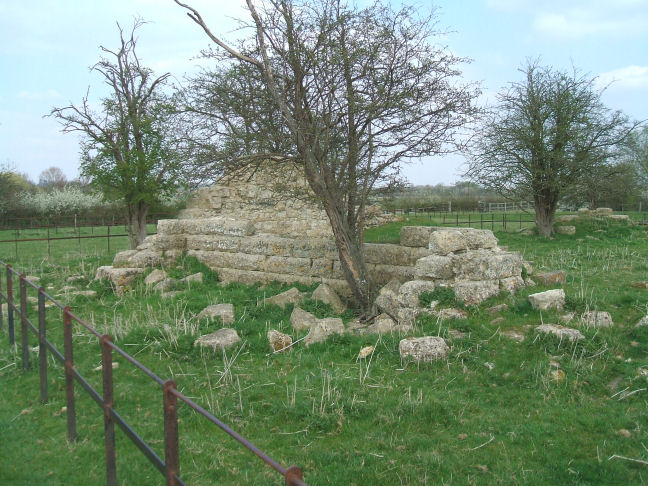
The village was largely depopulated by the seventeenth century, though the exact mechanism and date of desertion are debated. The church of St Peter survived as a ruin; its walls still stand to a substantial height in places, roofless but dramatic, surrounded by the earthworks of the abandoned village. The moated manor site lies nearby, its waters dried out but its outline clear from any elevated viewpoint.
Sir Henry Lee and the Elizabethan court
Sir Henry Lee is one of the more colourful figures of the Elizabethan age, and his connection to Quarrendon gives the village a historical resonance far beyond its modest physical size. He was born around 1533, probably at Quarrendon, and entered court service in the 1550s. His relationship with Elizabeth was close and apparently genuine: she visited Quarrendon on at least two occasions, in 1572 and 1592, receiving elaborate entertainments that Lee organised at considerable personal expense.
As Queen's Champion and organiser of the Accession Day Tilts, Lee presided over the most elaborate theatrical celebrations of the Elizabethan regime. The tilts — formal jousting tournaments held annually in the Whitehall tiltyard — were as much political theatre as sport: knights entered in allegorical costumes, with elaborate devices and mottos, acting out the mythology of loyal service to a semi-divine sovereign. Lee was the architect of this mythology and its most persistent performer. His retirement ceremony in 1590, at which he was succeeded by the Earl of Cumberland, involved a masque, a speech, and the presentation of his armour at an altar to the goddess of chastity — a piece of Elizabethan political theatre at its most self-conscious.
Lee's private life was less chivalrically conventional. His long-term companion Anne Vavasour had been a lady-in-waiting whose affair with the Earl of Oxford had caused a court scandal in 1581. Lee and Anne lived together at Quarrendon from the early 1590s until his death in 1611. He left her a substantial bequest, recognising their relationship despite the lack of formal marriage. The contrast between his public role as the champion of Elizabethan chastity and his private domestic arrangements was not lost on his contemporaries.
The ruined church of St Peter
The church of St Peter at Quarrendon survives as a substantial ruin visible from the public footpath that crosses the site. The nave walls stand to several metres in height, with intact window openings and the remains of the west tower. The chancel is lower but identifiable. The overall plan — nave, chancel, tower, and a south aisle — is typical of a medium-sized English parish church of the twelfth to fifteenth centuries, and the surviving fabric spans several building phases.
The church contains, or contained, monuments to the Lee family. Heraldic records describe a chapel or aisle used by the Lees for family burials, and there are references to Lee monuments that were present in the church before the building fell into disuse and ruin. Whether any monument material survives in situ is unclear — the site has been subject to limited archaeological investigation and some removal of stonework over the centuries — but the association with one of Elizabeth I's most prominent courtiers gives the ruins a significance beyond typical local archaeology.
The church fell out of regular use as the population of Quarrendon declined. Without a congregation to maintain it and without the income from tithes and pew rents that sustained rural churches, the fabric deteriorated. The roof failed, the walls began to settle, and by the eighteenth century the building was a picturesque ruin. It is now a scheduled monument, protected from further deliberate disturbance, though the natural processes of decay continue.
The moated site and landscape archaeology
The moated site at Quarrendon — the location of the medieval and Elizabethan manor house — lies immediately north-west of the ruined church. The moat itself is largely dry, but its outline is clear: a roughly rectangular ditch enclosing a raised platform approximately 60 by 80 metres. This is the area occupied by the Lee family's principal residence.
The manor house Sir Henry Lee occupied and improved was a substantial Elizabethan building, set within formal gardens that he developed in the fashionable Italian-influenced style of the 1570s and 1580s. The gardens were noted by contemporaries and are referenced in royal progress accounts as worthy of royal entertainment. No above-ground remains of the house or gardens survive, but earthwork surveys have revealed the outlines of garden terraces, a formal water feature, and other landscape features consistent with an Elizabethan garden of ambition.
The broader earthworks of the village extend around the church and moated site. House platforms, lane holloways, and the boundaries of former closes are identifiable in the pasture to the east. A second moated site — possibly a secondary manorial enclosure or a later farm complex — lies to the south. The total area of earthworks forms one of the more complex deserted village landscapes in Buckinghamshire, reflecting the superimposition of several phases of settlement and estate development.
Access and further research
The Quarrendon earthworks are accessible on foot via public footpaths from the village of Hardwick to the south. The path crosses the site and allows close inspection of the church ruins and the moated platform. The site lies within the modern boundary of Aylesbury — Quarrendon is now effectively a suburb — but the open fields around the earthworks have been preserved from development, and the site retains a surprising sense of isolation given its urban fringe location.
Buckinghamshire Archives in Aylesbury holds the relevant manorial records, estate papers, and Lee family documents for the Quarrendon area. The Victoria County History for Buckinghamshire (volume IV) contains a detailed account of the manor's history from Domesday through to the post-medieval period. The Historic England record for the scheduled monument provides an authoritative description of the earthworks and their archaeological significance.
For genealogists, the parish registers for Quarrendon and the adjoining parish of Hardwick are held at Buckinghamshire Archives. The combination of a documented major family (the Lees), a clear Domesday entry, and well-preserved earthworks makes Quarrendon one of the more rewarding deserted village sites in southern England for structured historical research.
See the full research report for Quarrendon, Buckinghamshire
Scheduled monuments, Domesday records, geology, Roman roads, historical literature: the same report Aubrey generates for paying customers, free to read.
View full reportGet an Aubrey report for anywhere in the UK
An Aubrey Research report for the Quarrendon area would map all PAS-recorded finds from the Aylesbury Vale, identify every scheduled monument within five kilometres, and cross-reference the Domesday entries for Quarrendon and its neighbours. The soils of the Aylesbury Vale are productive detecting country, with regular medieval and Roman finds emerging from the fields. For researchers and detectorists working in Buckinghamshire, Aubrey provides the complete historical picture of any location in the county.
Start your reportEverything a full report reveals about Quarrendon, Buckinghamshire
You have just read the story of Quarrendon, Buckinghamshire. A full Aubrey report pulls together everything the record actually holds about a place, from the geology beneath it to the last coin dropped in a field:
Every location is different. Not every section appears for every place, only what the historical record actually holds turns up in a report.