Norse Raid on Tavistock Monastery 997
Who Fought
History & Significance
The 960s decade ran from January 1, 960, to December 31, 969.
Summer – Siege of Chandax: A Byzantine fleet with an expeditionary force (comprising about 50,000 men) under Nikephoros Phokas lands on Crete. Nikephoros defeats the Muslim resistance and begins a siege at the capital of Chandax. He decides to blockade the city for the winter, while his engineers begin to construct siege engines. Emir Abd al-Aziz ibn Shu'ayb sends for aid by the Fatimids in Ifriqiya and the Caliphate of Córdoba (modern Spain).
November 8 – Battle of Andrassos: The Byzantines under Leo Phokas the Younger defeat the Hamdanid army (30,000 men) in an ambush in the passages of the Cilician mountains, in south Asia Minor (modern-day Turkey). Emir Sayf al-Dawla barely manages to escape, and returns to Aleppo with only 300 horsemen. The Hamdanids can no longer afford to raid in Anatolia, which is a turning point in the Arab-Byzantine wars in the East.
Mieszko I, a duke of the Piast Dynasty, becomes prince (de facto ruler) of Poland on the death of his father Siemomysł. Mieszko continues to subdue the neighbouring tribes under his control. Two obstacles to this plan are the Western Slav tribal group, the Veleti (also known as the Wilzi or "Wolf people") who are raiding Mieszko's lands for plunder; and the Saxon border dukes, who are pushing eastwards in search of new lands to conquer.
Harald Bluetooth, king of Denmark, consolidates his rule over Jutland and Zealand. He adopts Christianity, erecting a carved stone at Jelling to honour his parents. It features a runic inscription (best-known in Denmark) and an image of Christ surrounded by interlace. The other Scandinavian kingdoms slowly convert to Christianity (approximate date).
June/July – Adalbert II, co-ruler and the son of King Berengar II, with the support of Duke Hugh of Tuscany, invades the Papal States under Pope John XII. With Lombard forces closing in on Rome, a papal delegation is sent to King Otto I (the Great) to appeal for assistance.
Autumn – Oberto I, margrave of the Obertenghi family, takes refuge in Germany. He travels with influential Italian leaders to the Saxon court of Otto I to intervene in Italy to protect him from Berengar II.
Richard I (the Fearless), duke of Normandy, marries Emma of Paris. She is the daughter of Hugh the Great, former Duke of the Franks. The union gives him a permanent status to the House of Capet.
Dunstan receives the pallium as archbishop of Canterbury from Pope John XII. He reforms monasteries and enforces the rule of Saint Benedict: poverty, chastity and obedience for monks.
The Kingdom of Aksum (modern Eritrea) is destroyed by Beta Israel invaders, under the leadership of Queen Gudit (approximate date).
The ground they fought on
The site of Norse Raid on Tavistock Monastery 997 lies on Unnamed Extrusive Rocks, Carboniferous, bedrock that formed in the Carboniferous. The rock here is mafic lava and mafic tuff.
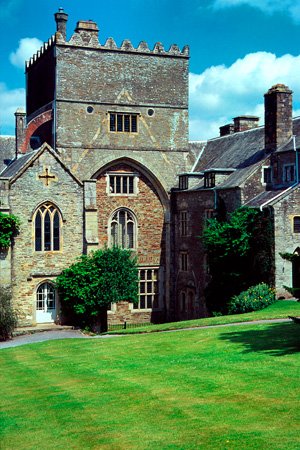
The only sourced detail relevant to Tavistock from these sources is that the abbey was established in 961, making it a relatively young institution at the time the raid is said to have occurred. No further detail about the raid itself is recorded in the provided sources.
Frequently Asked Questions
Everything a full report reveals about Norse Raid on Tavistock Monastery 997
This page covers Norse Raid on Tavistock Monastery 997. A full Aubrey report for the area pulls together this battle alongside scheduled monuments and everything else the record holds within a few miles:
Every location is different. Not every section appears for every place, only what the historical record actually holds turns up in a report.
Scheduled Monuments near Norse Raid on Tavistock Monastery 997


Other Early Medieval Battles
Battles near Norse Raid on Tavistock Monastery 997
Explore the landscape around Devon
Aubrey generates in-depth historical research for any location in the UK — drawing on Domesday records, scheduled monuments, Victorian OS maps, geological data and archaeological archives to tell the full story of a place.
- 960s · Wikipedia
- South West England · Wikipedia