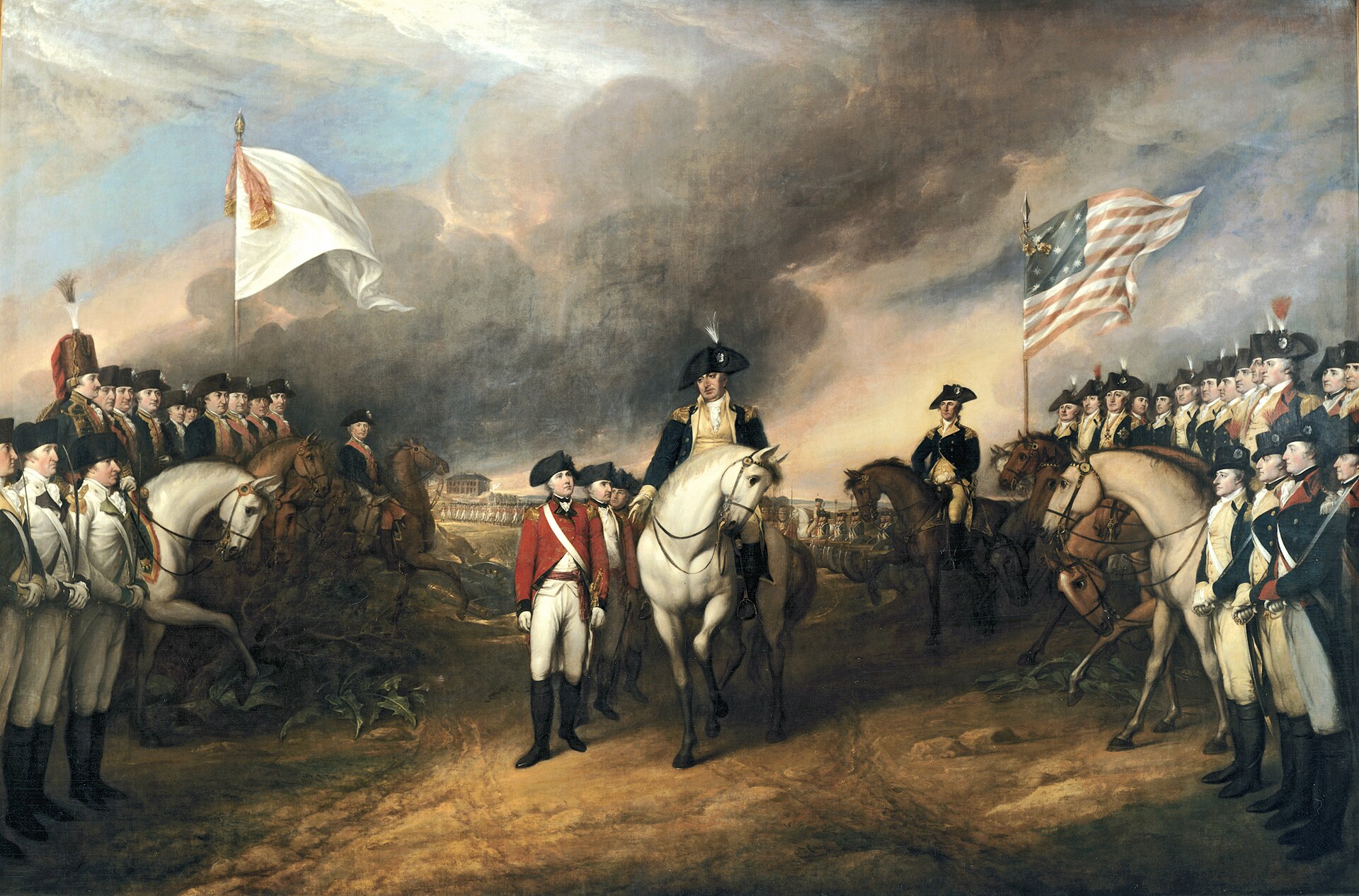
1781 marked the decisive turning point in the American Revolutionary War, the eight year conflict that had begun in 1775 when Patriot forces, organized as the Continental Army under George Washington, took up arms against the British. The year's central event was the Siege of Yorktown in Virginia, where a combined French and American force trapped British General Cornwallis. With the French navy blocking any escape by sea, Cornwallis was forced to surrender in October 1781. This defeat convinced King George III and the British government that the war could not be won, setting in motion the negotiations that would end with Britain formally recognizing American independence in the Treaty of Paris two years later.
Yorktown was the culmination of Britain's Southern Strategy, a plan pushed by Lord Germain and Loyalist advisers who believed the South offered easier pickings than the stubborn North. The reasoning was that with modest numbers of troops and support from local Loyalists, Britain could secure the profitable southern colonies, then use naval control of the Atlantic coast to squeeze Congress into surrender. Early results seemed promising: British forces captured Savannah in late 1778 and, after reinforcement under Cornwallis and Henry Clinton, took Charleston in May 1780, a defeat so severe that over 5,000 Patriot prisoners were captured and the Continental Army's southern forces were effectively wiped out. But Loyalist support proved far weaker than British planners had assumed, and Cornwallis found he needed many more regular troops than expected to hold the region.
That overreach ultimately led Cornwallis northward into Virginia, where his army became trapped at Yorktown by Washington's combined Franco-American force. His surrender there in October 1781 did not immediately end the fighting, since Britain remained at war with France and Spain for two more years, but large-scale combat in North America effectively stopped. The eventual Treaty of Paris, signed in September 1783, confirmed what Yorktown had already made clear: Great Britain would recognize the independence of the United States, bringing the Revolutionary War to its close.
Written by Aubrey Research from American Revolutionary War on Wikipedia, cited as a reference and not reproduced.
Where these engagements were fought
Select a marker to see the engagement and open its page.
Engagements of 1781.
Notable engagements of 1781
| Engagement | Year | State | Outcome | Forces or losses |
|---|---|---|---|---|
| Cowpens | 1781 | SC | American victory | United States: 25 killed ; 124 wounded; Great Britain: 110 k |
| Yorktown | 1781 | VA | American victory | 88 killed; 301 wounded; Total: 389; Hesse-Kassel: 142-309 ki |
| Pensacola | 1781 | FL | Spanish victory | Losses: 297; 95 killed; 202 wounded; Waldeck Choctaw Creek: |
| Hobkirk Hill | 1781 | SC | British victory | United States: 19 killed; 113 wounded; 89 captured; 50 missi |
| Johnstown | 1781 | NY | American victory | Total Losses:41; 12 killed; 24 wounded; 5 captured; 25px Hau |
| Green Spring | 1781 | VA | British victory | United States: 28 killed ; 122 wounded; 75 killed and wounde |
| Chesapeake Capes (1) | 1781 | VA | French victory | France: 220 killed or wounded; Great Britain: 90 killed ; 24 |
| Cowan'S Ford | 1781 | NC | British victory | 4 killed; 36 wounded; United States: 4 killed ; Wounded unkn |
| Elizabethtown | 1781 | NJ | Patriot victory | Loyalist militia: 17 killed; Patriot militia: 4 wounded |
| Fort Balfour | 1781 | SC | Americans victory | American: 0 killed, 2 wounded |
| Eutaw Springs | 1781 | SC | Surveyed battlefield | Great Britain: 85 killed ; 297 wounded ; 70 captured; United |
| Battle of Fort Slongo | 1781 | NY | American victory | 1 wounded; 4 killed; 2 wounded; 21 captured |
Plus 117 further documented engagements in the 1781 record.
Battlefield locations and boundaries are compiled from public records, including the National Park Service American Battlefield Protection Program (public domain) and the American Revolution GIS work of Charles E. Frye (CC BY-SA 4.0).