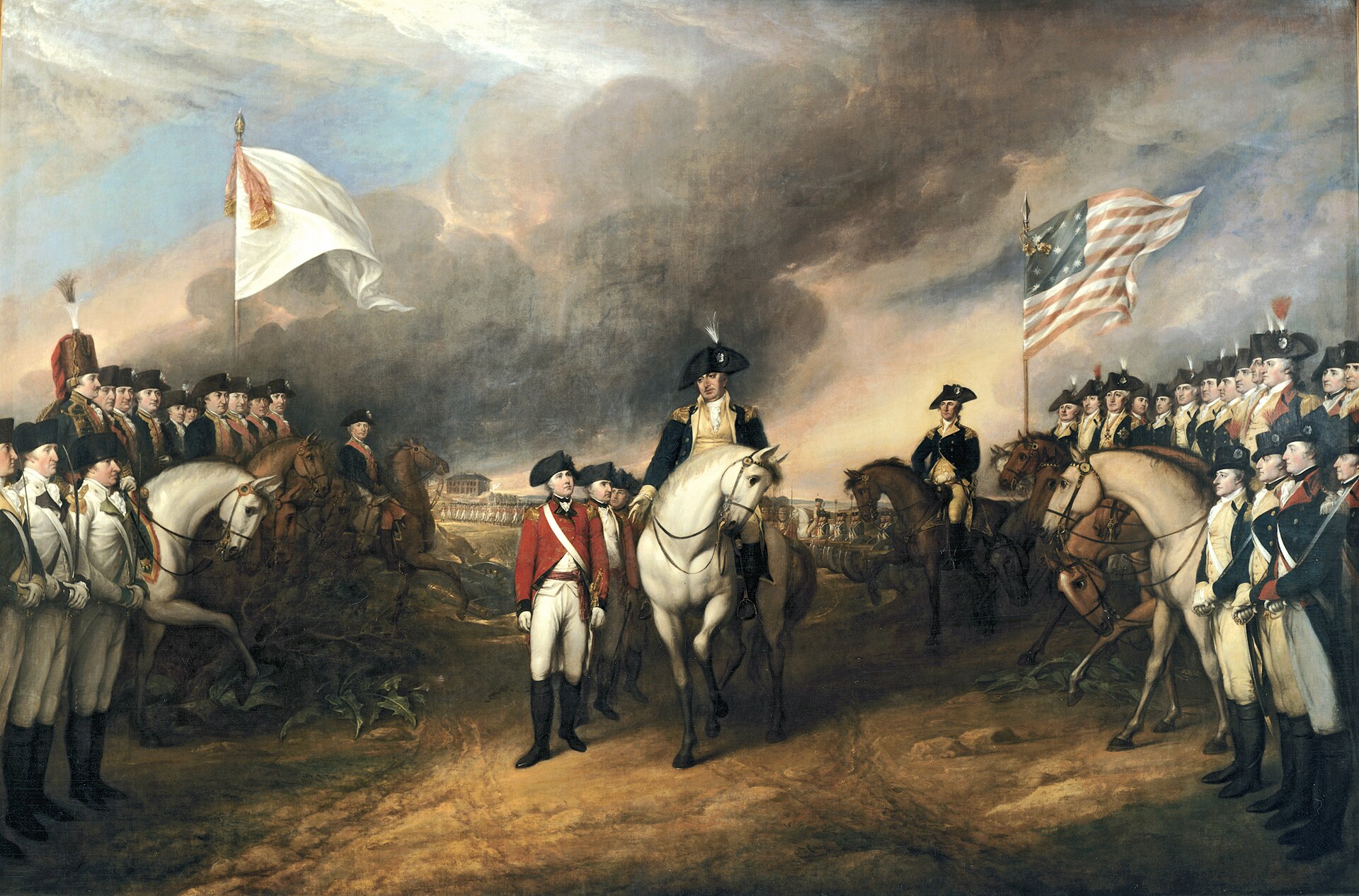
The American Revolutionary War ran from April 19, 1775, to September 3, 1783, and marked the eight-year military struggle that decided American independence from Britain. On one side stood the Continental Army, made up of American Patriot forces and commanded by George Washington. On the other stood the British Army, backed by the might of the British Empire. Fighting stretched across North America, the Caribbean, and the Atlantic, and for most of its course the war's outcome was far from certain. That changed in 1781, when Washington and his forces won a decisive victory at the Siege of Yorktown, forcing King George III and Great Britain to seek an end to the conflict. Two years later, the Treaty of Paris settled the matter for good: Britain formally recognized the independence of the Thirteen Colonies, giving birth to the United States as a sovereign nation.
The war grew out of years of rising friction between Britain and its American colonies, fueled by taxes like the Stamp and Townshend Acts and by incidents such as the Boston Massacre in 1770. When Parliament passed the Intolerable Acts in 1774 in an effort to disarm the colonists, tensions boiled over into open combat at Lexington and Concord in April 1775. That June, the Second Continental Congress folded local militias into the newly formed Continental Army and named Washington its commander. By August, George III had declared the colonies to be in rebellion, and in July 1776 Congress made the break official, passing the Lee Resolution and then adopting the Declaration of Independence on July 4.
Early fighting saw the Continental Army push the British out of Boston in March 1776, only for British commander William Howe to seize New York City later that year. Washington answered with his famous crossing of the Delaware River and narrow but morale-boosting wins at Trenton and Princeton. The tide turned further in October 1777, when British General John Burgoyne surrendered at Saratoga, a defeat that convinced France, and later Spain, to back the American cause; France signed a formal alliance with the Americans in 1778. Fighting later shifted south under British commander Henry Clinton, where General Cornwallis found early success before being trapped at Yorktown in 1781, cut off by the French navy and forced to surrender. Although Britain's wars with France and Spain dragged on two more years, the fighting in America was effectively over. The Treaty of Paris, signed September 3, 1783, sealed American independence, while related agreements in Versailles settled Britain's disputes with France and Spain, costing Britain territories including Tobago, Senegal, Menorca, and Florida.
Written by Aubrey Research from American Revolutionary War on Wikipedia, cited as a reference and not reproduced.
By theater
Three geographic theaters organize the war: the Northern main-army campaigns, the Southern partisan war, and the Western frontier.
By state
Select a state on the map to see its engagements, the forces involved and its chronology.
By year
The chronological arc runs from Lexington in 1775 to the final actions of 1783, peaking with the Southern campaigns of 1780 and 1781.
Battlefield locations and boundaries are compiled from public records, including the National Park Service American Battlefield Protection Program (public domain) and the American Revolution GIS work of Charles E. Frye (CC BY-SA 4.0).