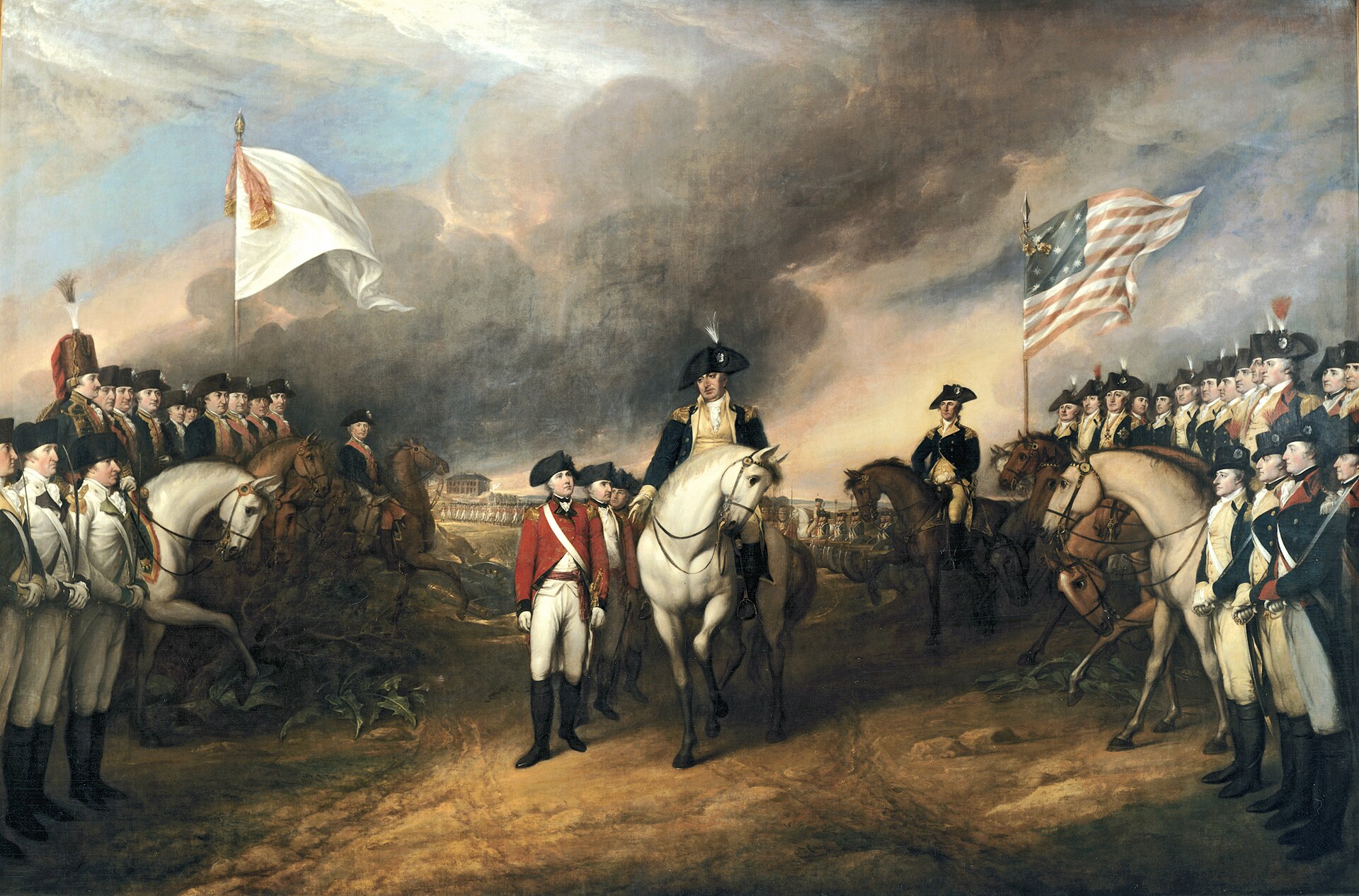
The Southern Theater was the main arena of fighting during the second half of the American Revolutionary War, running from 1778 to 1781 across Georgia, South Carolina, North Carolina, and Virginia. It combined large set-piece battles with guerrilla warfare, and it ended with a decisive American and French victory at the siege of Yorktown, where British Lieutenant General Charles Cornwallis surrendered on October 19, 1781, effectively bringing major combat in the war to a close and opening the door to peace talks that produced the Treaty of Paris in 1783.
For the war's first three years, the heaviest fighting had taken place farther north, around Boston, New York, and Philadelphia. That changed after British General John Burgoyne's surrender at Saratoga in October 1777 pushed France into a formal alliance with the Americans in 1778, turning the conflict into a much wider war. With France now involved, Britain shifted troops toward defending its Caribbean colonies and pivoted its mainland strategy southward, betting on strong Loyalist support in Georgia and the Carolinas. This "Southern Strategy" opened with the capture of Savannah in late 1778, followed by major British wins in South Carolina in 1780, including the fall of Charleston and the defeat of Horatio Gates's forces at Camden. Spain, having entered the war against Britain in 1779, added another front by seizing all of British West Florida, capped by the siege of Pensacola in 1781.
Command of the Continental Army in the south then passed to Nathanael Greene, who avoided risky direct confrontations in favor of wearing the British down through attrition. The campaign that followed included a mix of outcomes: British tactical victories such as Guilford Courthouse that came at devastating cost, alongside important American successes at Ramseur's Mill, Cowpens, and Kings Mountain that steadily drained British strength. By 1781, with French naval power and thousands of French troops marching south from New York to join George Washington, the combined allied forces cornered Cornwallis at Yorktown, whose surrender there marked the effective end of large-scale fighting in the Revolutionary War.
Written by Aubrey Research from Southern theater of the American Revolutionary War on Wikipedia, cited as a reference and not reproduced.
Chronology
Fighting in the southern theater spanned 1775 to 1782. Select a year to see the engagements of that campaign season across all theaters.
Where these engagements were fought
Select a marker to see the engagement and open its page.
Red markers are surveyed battlefields with a mapped boundary; navy markers are point-located engagements. Select a marker to open its page.
Notable engagements
| Engagement | Year | State | Outcome | Forces or losses |
|---|---|---|---|---|
| Camden | 1780 | SC | British victory | Total:324; 68 killed; 245 wounded; 11 missing; United States |
| Kings Mountain | 1780 | SC | American victory | United States: 28 killed; 62 wounded; 157 killed; 163 wounde |
| Cowpens | 1781 | SC | American victory | United States: 25 killed ; 124 wounded; Great Britain: 110 k |
| Yorktown | 1781 | VA | American victory | 88 killed; 301 wounded; Total: 389; Hesse-Kassel: 142-309 ki |
| Pensacola | 1781 | FL | Spanish victory | Losses: 297; 95 killed; 202 wounded; Waldeck Choctaw Creek: |
| Baton Rouge | 1779 | LA | Spanish victory | 9 killed; 39 wounded; Waldeck-Pyrmont: 4 killed; 2 wounded; |
| Waxhaws | 1780 | SC | British victory | Total: 15; 5 killed; 12 wounded; Total: 319; 113 killed; 150 |
| Ramsour's Mill | 1780 | NC | Patriot victory | Patriot militia: Around 150 killed/wounded; Loyalist militia |
| Hobkirk Hill | 1781 | SC | British victory | United States: 19 killed; 113 wounded; 89 captured; 50 missi |
| Kemp's Landing | 1775 | VA | British victory | Virginia Committee of Safety; Patriot militia: 7 killed; 18 |
| Great Bridge | 1775 | VA | Patriot victory | Virginia Committee of Safety; Patriot militia: 1 wounded; Pr |
| Thomas Creek | 1777 | FL | British victory | United States: 4-8 killed; 9 wounded; 31-34 captives (of who |
Plus 184 further documented engagements in the Southern Theater record.
By state
Each state hub covers the engagements fought there, the forces involved and its chronology.
Battlefield locations and boundaries are compiled from public records, including the National Park Service American Battlefield Protection Program (public domain) and the American Revolution GIS work of Charles E. Frye (CC BY-SA 4.0).