BattlefieldsDudley Conspiracy Arrests 1556
Tudor

Dudley Conspiracy Arrests 1556

1556
Warwickshire, England
Era
Tudor
Battle Type
Pitched Battle
Location
Warwickshire, England
Status
Unregistered
Outcome
Plot crushed; several conspirators executed; Marian regime temporarily shaken.
The Battle

History & Significance

Henry Dudley (c. 1531 – 10 August 1557) was an English soldier and an elder brother of Queen Elizabeth I's favourite, Robert Dudley, Earl of Leicester. Their father was John Dudley, Duke of Northumberland, who led the English government from 1550 to 1553 under Edward VI and unsuccessfully tried to establish Lady Jane Grey on the English throne after the King's death in July 1553. For his participation in this venture Henry Dudley was imprisoned in the Tower of London and condemned to death, but pardoned.

Henry Dudley was born c. 1531 and was the seventh son of Sir John Dudley, later Viscount Lisle, Earl of Warwick and Duke of Northumberland, and his wife Jane Guildford. The Dudley lineage goes back to a family called Sutton. In the early 14th century they became the lords of Dudley Castle, from whom Henry descended through his paternal grandfather. This was Edmund Dudley, a councillor to Henry VII, who was executed after his royal master's death. Through his father's mother, Elizabeth Grey, Viscountess Lisle, Guildford descended from the Hundred Years War heroes, Richard Beauchamp, Earl of Warwick, and John Talbot, 1st Earl of Shrewsbury.

When Henry was born, his father was a knight, in 1537 he became vice-admiral and later Lord High Admiral. Under the young King Edward VI, Henry's father became Lord President of the Privy Council and de facto ruled England from 1550 to 1553. In 1542 John Dudley was created Viscount Lisle, later was created Earl of Warwick and then Duke of Northumberland in October 1551. Henry's mother served as a lady-in-waiting to Anne Boleyn, and later to Anne of Cleves. She was interested in the Reformed religion and, with her family, moved in evangelical circles from the mid-1530s. All Dudley's children grew up in a Protestant household and enjoyed a humanist education. Henry Dudley and his brothers were trained by, among others, the mathematician John Dee.

In January 1553 the King became ill and by the beginning of June his condition was hopeless. For more than a year, the Imperial ambassador Jehan de Scheyfye had been convinced of Northumberland being engaged in some "mighty plot" to settle the Crown on his own head. Always looking out for signs as to this respect, he reported talk that the Duke was contemplating the divorce of his eldest son to marry him to Princess Elizabeth. In fact, it was Henry's youngest brother, Guildford Dudley, who had recently been married on King's favourite cousin Lady Jane Grey. Lady Jane was to ascend the English throne after the King's death, according to Edward's will, headed "My Devise for the Succession", in which he bypassed his half-sisters Mary and Elizabeth. In 21 June hundred and two personages signed the letters patent, which were supposed to settle the Crown on Jane. King Edward VI died on 6 July. On 10 July Jane and Guildford made their ceremonial entry into the Tower of London. The same day as Jane's proclamation, a letter from Mary Tudor arrived in London, saying that she was now queen and demanding the obedience of the Council.

The ground

The ground they fought on

The site of Dudley Conspiracy Arrests 1556 lies on Warwickshire Group, bedrock that formed in the Early Permian. The rock here is mudstone, siltstone, sandstone, coal, ironstone and ferricrete.

Questions & Answers

Frequently Asked Questions

Unlimited access

Everything a full report reveals about Dudley Conspiracy Arrests 1556

This page covers Dudley Conspiracy Arrests 1556. A full Aubrey report for the area pulls together this battle alongside scheduled monuments and everything else the record holds within a few miles:

Overview
An interactive map of the location with every monument and battle plotted, and a plain-language history built only from what the record holds.
Monuments
The legally protected scheduled monuments around the location, each with its period, type and significance.
Battlefields
The battles and sieges fought on this ground, mapped and set on a timeline of the wider conflict.
Roman Britain
The Roman roads, forts and towns near here, and the Iron Age people who held the land before Rome arrived.
Domesday
The settlement's entry in the 1086 Domesday Book: who held it, what it was worth, and the people who worked the land.
Civil War
The Civil War fighting, garrisons and recorded militaria in this area, woven into the arc of 1642 to 1651.
Geology
The bedrock beneath the site, its age and rock type, reaching back hundreds of millions of years.
LiDAR
Laser-scanned terrain that reveals earthworks hidden under fields and woodland, with likely features flagged.
Local Names
What the street and field names around here actually mean, and the history buried inside them.
Historical Maps
Ordnance Survey maps from the 1800s, layered over the location as it stands today.
Literature
The books, county histories, charters and archives that mention this place, quoted with their sources.
Legal
The protected sites nearby and the metal-detecting, access and treasure laws that apply to this ground.
Spotlight
A deep dive into the most remarkable, lesser-known history of the place, traced back to the record.
Target Zones
For detectorists: the most promising ground to search nearby, ranked by confidence, with what to expect.
Timeline
The whole story of the location told era by era, from prehistory to the present day.
First month just £4.99, then £9.99 a month. Unlimited locations, cancel anytime.

Every location is different. Not every section appears for every place, only what the historical record actually holds turns up in a report.

Start your Dudley Conspiracy Arrests 1556 report
Or see a real report first
Protected heritage nearby

Scheduled Monuments near Dudley Conspiracy Arrests 1556
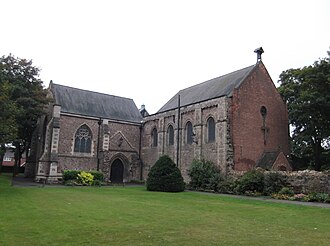
The Benedictine priory and precinct of St Mary, Nuneaton
Scheduled monument · ~1.3 mi

St Mary's Priory at Nuneaton is a Benedictine priory founded in the eleventh century, originally established as a cell of the English monastery of Fontevraud Abbey before becoming independent. The priory operated as a major religious and economic centre in medieval Warwickshire until its dissolut…

JohnArmagh / CC BY-SA 3.0 / Wikimedia Commons
Hartshill Castle
Hartshill Castle
Scheduled monument · ~2.9 mi

Hartshill Castle is a motte-and-bailey fortification located in Warwickshire, dating to the Norman period following the conquest of 1066. The castle comprises an earthwork mound surrounded by a ditch, typical of early Norman military architecture, with evidence of timber fortifications that would…

Brett Lees-Smith from Nuneaton, Warwickshire,, United Kingdom / CC BY-SA 2.0 / Wikimedia Commons
Deserted village of Stretton Baskerville
Scheduled monument · ~4.5 mi

Deserted village of Stretton Baskerville is a medieval settlement site located in Warwickshire that was abandoned during the post-medieval period. The village is documented as existing in the medieval period but fell into decline, leaving behind earthwork remains and archaeological deposits that…

A J Paxton / CC BY-SA 2.0 / Wikimedia Commons
Caludon Castle: a moated site and part of an associated water management system
Scheduled monument · ~6.5 mi

Caludon Castle is a moated site located in Warwickshire, England, representing the earthwork remains of a medieval fortified residence. The castle comprises a substantial mound surrounded by a water-filled moat, which formed part of an integrated water management system that served both defensive…

Mum's taxi (Wikipedia Takes Coventry participant) / CC BY-SA 3.0 / Wikimedia Commons
Cook Street Gate
Cook Street Gate
Scheduled monument · ~6.7 mi

Cook Street Gate is a timber-framed gatehouse structure located in Warwickshire, dating to the medieval period. The gateway stands as evidence of the settlement patterns and defensive or administrative infrastructure of its era, with its timber construction being characteristic of medieval buildi…

E Gammie / CC BY-SA 2.0 / Wikimedia Commons
Motte castle 150m SSW of Allesley Hall
Scheduled monument · ~7 mi

Motte castle 150m SSW of Allesley Hall is a Norman motte-and-bailey earthwork situated in Warwickshire. The monument consists of a substantial mound of earth forming the motte, characteristic of defensive structures erected in the Norman period following the conquest of 1066. The castle exemplifi…

Anthony Vosper / CC BY-SA 2.0 / Wikimedia Commons
Astley Castle moated site, fishponds, garden remains and Astley College
Scheduled monument · ~2.2 miles
Moated site at Exhall Hall
Scheduled monument · ~3.1 miles
Aubrey Research

Explore the landscape around Warwickshire

Aubrey generates in-depth historical research for any location in the UK — drawing on Domesday records, scheduled monuments, Victorian OS maps, geological data and archaeological archives to tell the full story of a place.

Research a location near WarwickshireView a sample report